
Corresponding Angles Theorem (Parallel Lines & Transversal)
Loading the math board and drawing, please wait…
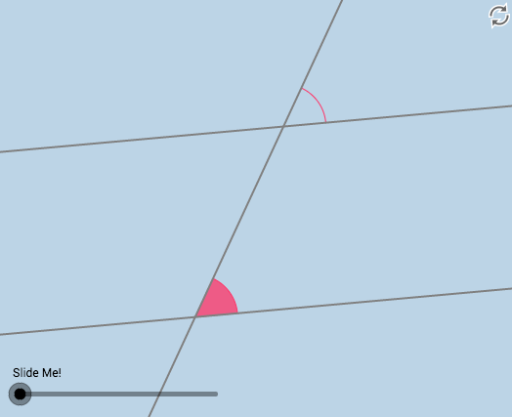
This GeoGebra activity dynamically illustrates the Corresponding Angles Theorem by showing how parallel lines intersected by a transversal produce equal corresponding angles. Core mathematical concepts include parallel line properties, angle congruence, and basic similarity transformations. Construction utilizes GeoGebra commands such as Point, Line, Angle, Rotate, Translate, and Dilate, along with geometric objects like points, lines, circles, and transformed figures. Suitable for middle to high school geometry courses, it supports angle property verification, proof assistance, and interactive exploration of Euclidean geometry fundamentals.
GeoGebra Commands & Parameters
Point(a) → BRotate(B, α, A) → B'Angle(B, A, B') → βLine(A, B') → bCircle(A, 1) → eIntersect(b, d) → CCircle(C, 1) → fIntersect(e, a) → D, EIntersect(e, b) → F, GIntersect(f, b) → H, IIntersect(f, d) → J, KCircleSector(C, K, I) → gCircleSector(C, I, J) → hCircleSector(C, J, H) → kCircleSector(C, H, K) → pCircleSector(A, E, G) → qCircleSector(A, G, D) → rCircleSector(A, D, F) → sCircleSector(A, F, E) → tDilate(A, If[0 < i < 1, 1 - i, 0], C) → A'Vector(A, A') → uTranslate(q, u) → q'Translate(r, u) → r'Translate(s, u) → s'Translate(t, u) → t'CircleArc(A, E, G) → c_1CircleArc(C, K, I) → d_1CircleArc(C, I, J) → e_1CircleArc(A, G, D) → f_1CircleArc(A, D, F) → g_1CircleArc(C, J, H) → h_1CircleArc(A, F, E) → k_1CircleArc(C, H, K) → p_1