
Convex Lens Ray Diagram
Loading the math board and drawing, please wait…
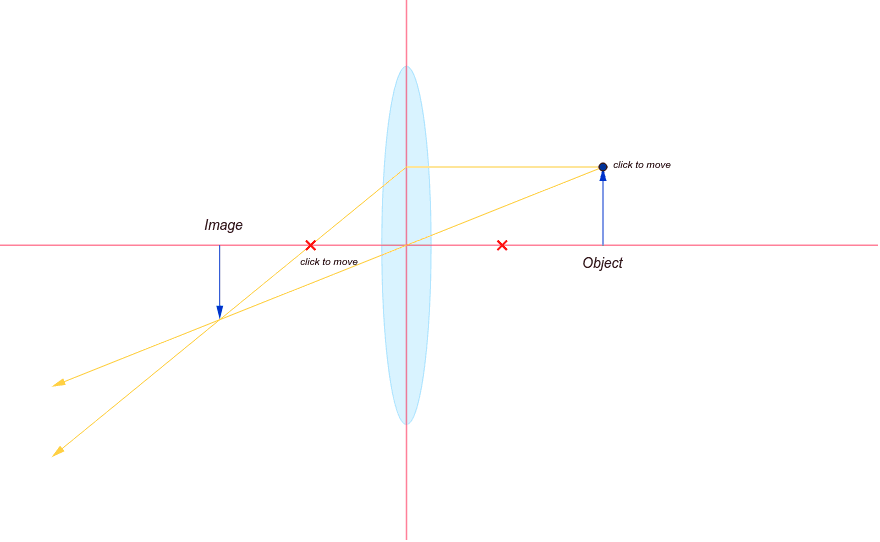
This example demonstrates the ray tracing for a convex (converging) lens using ray diagrams. Key mathematical concepts include refraction of light, focal points, optical axis, and geometric constructions. The construction utilizes GeoGebra commands like OrthogonalLine, Point, Intersect, Mirror, Ray, Vector, Ellipse, and Segment to accurately represent the lens and ray paths. Suitable for high school physics optics education or beginners learning about lens imaging principles.
GeoGebra Commands & Parameters
OrthogonalLine(A, xAxis) → cOrthogonalLine(A, b) → dPoint(a) → BIntersect(a, b) → CMirror(B, C) → B'Intersect(b, d) → DRay(D, B) → eRay(A, C) → fIntersect(e, f) → EOrthogonalLine(E, xAxis) → gIntersect(a, g) → FVector(F, E) → vIntersect(a, c) → GVector(G, A) → wRay(C, A) → iRay(B, D) → jIntersect(i, j) → JOrthogonalLine(J, xAxis) → kIntersect(a, k) → KVector(K, J) → lPoint(b) → NPoint(b) → OEllipse(N, O, P) → pSegment(A, D) → uIntersect(q, e) → QIntersect(q, f) → RVector(D, Q) → zVector(A, R) → hIntersect(r, i) → HIntersect(j, r) → ISegment(D, I) → mSegment(A, H) → n
AI Drawing Prompt Reference
Draw a convex lens ray diagram, including the lens, two main rays (one parallel to the optical axis before the lens and one perpendicular to the optical axis at the edge of the lens), and their intersection point. First, draw the optical axis and focal points of the lens. Then, draw two rays: one starting from the focal point and parallel to the optical axis, and another starting from the edge of the lens and perpendicular to the optical axis. These rays will intersect on the other side of the lens near the focal point, forming a real image. Finally, draw the boundary of the lens and the optical axis, as well as the paths of the rays.
The prompt above was compiled from the original drawing commands and is for reference only.