
Converse of Isosceles Triangle Theorem (Interactive Discovery)
Loading the math board and drawing, please wait…
In collections
Congruence (CO) Cluster
Congruence (Vol 2)
CCSS High School: Geometry (Congruence) Volume 2
CCSS High School: Geometry (Congruence) Volume 2
CCSS High School: Geometry (Congruence) Volume 2
Geometry (Congruence) Volume 2
CCSS High School: Geometry (Congruence) Volume 2
CCSS High School: Geometry (Congruence) Volume 2
CCSS High School: Geometry (Congruence) Volume 2
CCSS High School: Geometry (Congruence) Volume 2
CCSS High School: Geometry (Congruence) Volume 2
CCSS High School: Geometry (Congruence) Volume 2
CCSS High School: Geometry (Congruence) Volume 2
Gail LeBlancCCSS High School: Geometry (Congruence) Volume 2
CCSS High School: Geometry (Congruence) Volume 2
Triangle Theorems
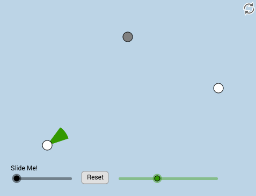
This interactive GeoGebra example demonstrates the converse of the Isosceles Triangle Theorem: if two angles of a triangle are equal, then the sides opposite those angles are equal. It focuses on the core mathematical concepts of isosceles triangles, angle-side relationships, and the logical structure of converse statements. The construction uses commands such as Rotate, Angle, Ray, Point, Intersect, Segment, Polygon, Min, Circle, CircleSector, Dilate, Vector, and Translate to build the triangle, angle bisectors, and dynamic auxiliary elements, with a button (button1) to guide step-by-step exploration. Suitable for middle or high school geometry classes, this resource encourages students to observe, conjecture, and verify the theorem's converse, enhancing their deductive reasoning and spatial visualization skills.
GeoGebra Commands & Parameters
Rotate(B, (-α), A) → B'Angle(B', A, B) → βRay(A, B') → fPoint(f) → CRotate(A, (-α), C) → A'Angle(A', C, A) → γRay(C, A') → gRay(A, B) → hIntersect(g, h) → DSegment(A, D) → iSegment(C, D) → jSegment(A, C) → kPolygon(A, C, D) → poly1, d, a, cMin(i, k) → eCircle(A, (0.2 * e)) → pIntersect(p, k, 1) → EIntersect(p, i, 1) → FCircleSector(A, E, F) → qDilate(A, If[0 < b ≤ 1, 1 - b, 0], C) → A'_1Segment(A, A'_1) → lVector(A, A'_1) → uTranslate(q, u) → q'Rotate(q', If[1 < b ≤ 2, ((b - 1) * (π - α)), π - α], C) → q''Dilate(A, If[2 < b ≤ 3, 3 - b, 0], D) → A'_2Dilate(C, If[2 < b ≤ 3, 3 - b, 0], D) → C'Segment(A, A'_2) → mSegment(C, C') → nRotate(A, If[3.5 < b ≤ 4.5, ((b - 3.5) * (π - (2 * α))), π - (2 * α)], D) → A'_3Rotate(A'_2, If[3.5 < b ≤ 4.5, ((b - 3.5) * (π - (2 * α))), π - (2 * α)], D) → GSegment(A'_3, G) → m'