
Converging Polygons Through a Dynamic Process
Loading the math board and drawing, please wait…
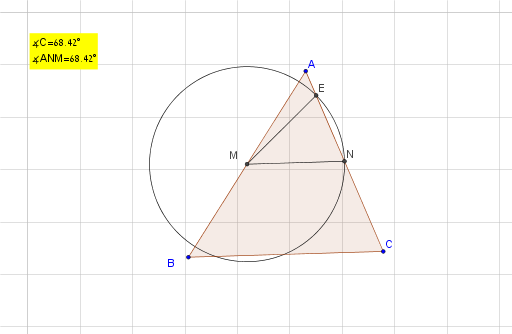
This example demonstrates how polygons converge to a perfect polygon through a dynamic process. Key mathematical concepts include polygons, angles, and geometric construction. It utilizes GeoGebra commands such as Polygon, Midpoint, Circle, Angle, Intersect, and Segment. Suitable for high school geometry students and educators.
GeoGebra Commands & Parameters
Polygon(A, B, C) → poly1, c, a, bMidpoint(c) → MCircle(M, (0.5 * Distance[B, C])) → dAngle(A, C, B) → γIntersect(d, b, 1) → NIntersect(d, b, 2) → EAngle(A, N, M) → αSegment(M, N) → fSegment(M, E) → g
AI Drawing Prompt Reference
Draw a triangle ABC, find the midpoint M of side BC, draw a circle with M as the center and radius half of BC, measure the angle BAC as γ, find the intersection points N and E of the circle with line segment AB, measure the angle MAN as α, and finally draw line segments MN and ME.
The prompt above was compiled from the original drawing commands and is for reference only.