
Construction of a Rhombus by Al Byrnes
Loading the math board and drawing, please wait…
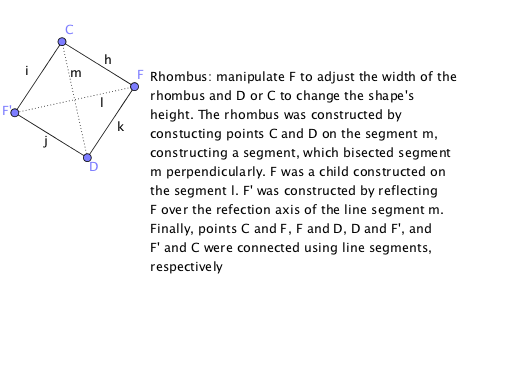
This example demonstrates how to construct a rhombus using geometric construction methods. The core math concepts involved include polygon, vector transformation, and geometric construction. Key construction steps utilize GeoGebra commands such as Line, Point, Midpoint, OrthogonalLine, Mirror, and Segment to accurately draw the rhombus's sides and vertices. Suitable for middle school and above students to understand the geometric properties and construction techniques of rhombuses.
GeoGebra Commands & Parameters
Line(A, B) → fPoint(f) → CPoint(f) → DMidpoint(C, D) → EOrthogonalLine(E, f) → gPoint(g) → FMirror(F, f) → F'Segment(F, C) → hSegment(C, F') → iSegment(F', D) → jSegment(F, D) → kSegment(F, F') → lSegment(C, D) → m
AI Drawing Prompt Reference
Draw a rhombus by first drawing a line f through points A and B, then taking points C and D on the line, finding the midpoint E of C and D, drawing a perpendicular line g to line f, taking point F on line g, mirroring F to line f to get F', and then connecting points C and F', F and D, F' and D, F and F', and C and D to form the four sides of the rhombus.
The prompt above was compiled from the original drawing commands and is for reference only.