
Constructing the Great Rhombicosidodecahedron (V=120) via trisection of 7th-orde
Loading the math board and drawing, please wait…
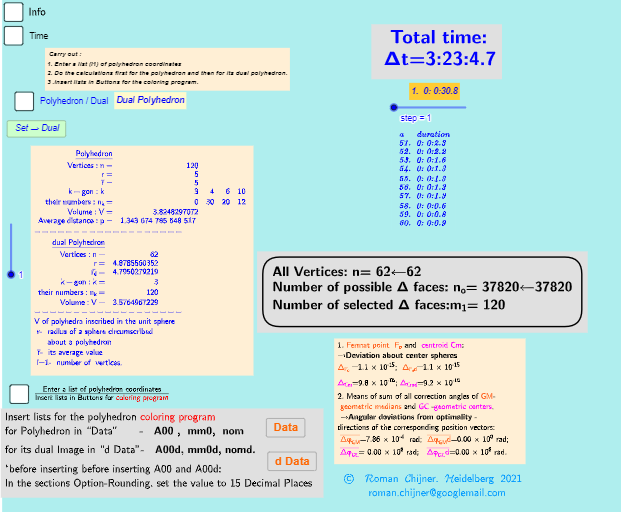
This example demonstrates how to obtain the Great Rhombicosidodecahedron with volume V=120 by taking a Biscribed Pentakis Dodecahedron and trisectioning its 7th-order segments. The construction highlights how subdividing specific higher-order segments determines the resulting vertices/edges and produces a well-defined 3D polyhedral solid. Key math ideas include solid-geometry relationships between related polyhedra (biscribed/inscribed structure), systematic segment subdivision (trisection at a chosen order), and volume/measure verification by comparing polyhedral-related quantities (e.g., volume terms derived from radius or sphere-related reference values). In GeoGebra, the build uses Text and TableText for labeling and tabulated results, Sum to aggregate computed values, If for conditional construction rules, Length together with Div, and Sequence to generate division steps and ordered point sets. It also relies on Element/IndexOf/First/Max to select critical objects from collections, and references parameters and volume-related variables such as Volsphere, Vol, Vol_r, Volsphere_d, A00/A00d, and r/r_d to connect the geometric construction to the target volume. Suitable for advanced secondary school geometry, contest preparation, and introductory university-level 3D geometry visualization.
GeoGebra Commands & Parameters
Text("" + p) → txt_pSum(Flatten[Sequence[Append[Sequence[Element[txt_p, i], i, m01(k), m02(k)], " "], k, 1, 5]]) → txtUm1If(bu0, A00, A00d) → A00_0Length(A00_0) → nLength(l2) → läl2Sequence(sgn(Determinant[{Element[A00_0, i1] - Element[A00_0, j], Element[A00_0, i2] - Element[A00_0, j], Element[A00_0, i3] - Element[A00_0, j]}]), j, 1, n) → l01Length(A00d) → zzzSum(Zip[(T * F), T, SysTimeAkt1, F, {1, 1000, 60000, 3600000, 86400000}]) → TimeAbs1Sum(Zip[(T * F), T, SysTimeAkt2, F, {1, 1000, 60000, 3600000, 86400000}]) → TimeAbs2Div(TimeRelab, 3600) → HDiv(TimeRelab - (H * 3600), 60) → MElement(ZwZeit, step) → text10TableText({Append["a duration", Last[ZwZeit, Min[10, Length[ZwZeit]]]]}, "v") → text2cLength(A00) → lm1If(Length[Unique[l01 \ {0}]] ≟ 1, 7, -7) → a7Sum(Zip[(T * F), T, SysTimeAkt0, F, {1, 1000, 60000, 3600000, 86400000}]) → TimeAbs0Div(TimeRelab0, 3600) → H0Div(TimeRelab0 - (H0 * 3600), 60) → M0Text("" + (TimeRelab0 - (H0 * 3600) - (M0 * 60))) → S0aText("" + (TimeRelab - (H * 3600) - (M * 60))) → SIndexOf(".", S) → indexIndexOf(".", S0a) → indexaFirst(S, index + 1) → txtSFirst(S0a, indexa + 1) → txtS0aIf(bu0, " ", "d") → txtbuoMax(Length[A00], Length[A00d]) → maxläElement(A00, 24) → m11TableText({{"\underline{Polyhedron}"}, Append["Vertices: n=", {Length[A00]}], Append["r=", {r}], Append["\bar{r}=", {r_m}], Append["k-gon : k=", mm5a], Append["their\; numbers: n_k=", mm7a], Append["Volume: V=", {Vol_r}], Append["Average\; distance: p=", {txtUm1}]}, "hr ") → text7TableText({{"\underline{dual\;Polyhedron}"}, Append["Vertices: n=", {Length[A00d]}], Append["r=", {r_d}], Append[" \bar{r_d}= ", {r_md}], Append["k-gon : k=", mm5ad], Append["their\; numbers: n_k=", mm7ad], Append["Volume: V=", {Vold_r}]}, "hr ") → text20
AI Drawing Prompt Reference
Construct a Great Rhombicosidodecahedron with volume 120 by starting from a biscribed pentakis dodecahedron and performing trisection on its 7th-order segments. Systematically subdivide specific higher-order segments to determine the final vertices and edges. Display key parameters including vertex count n, face types k_gon, numbers of each face n_k, circumradius r, and volume V. Also show the dual polyhedron with its corresponding geometric data, using tables to compare vertex counts, radii, and volumes between the two polyhedra to verify the construction accuracy.
The prompt above was compiled from the original drawing commands and is for reference only.