
Constructing Similar Triangles via Symmetry and Angle Control
Loading the math board and drawing, please wait…
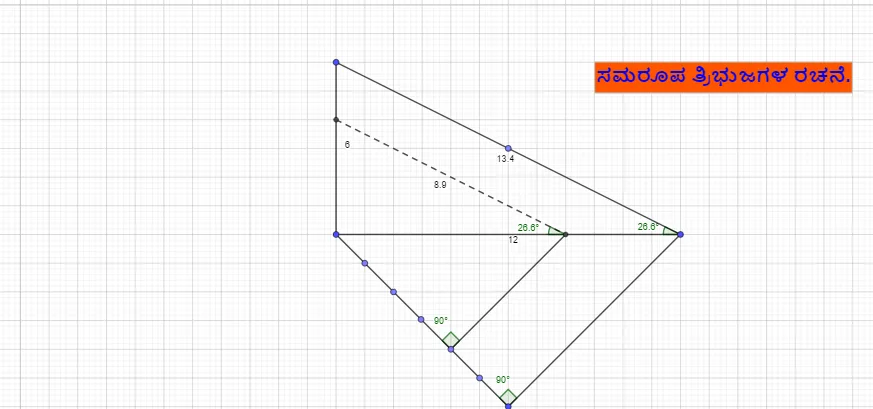
This example demonstrates how to construct similar triangles under given geometric constraints, using symmetry-related ideas and strict angle control to ensure corresponding sides are proportional and corresponding angles are equal. The key mathematics includes the similarity concept (e.g., angle-angle style reasoning), the scale-factor viewpoint behind similar transformations, and geometric construction logic that locates vertices via intersections. Construction workflow: Segment, Point, Line, and Ray set up the base elements and auxiliary rays; Intersect determines the critical vertex positions from the intersections; Angle is used to construct and verify target angles (such as α, β, γ, δ); Polygon then connects the computed points to form the final similar-triangle shape. The construction is organized around key points (A, B, C, D, E, F, G, H, etc.) and named lines/rays (f, g, h, i, m, n, etc.), with text labels (e.g., text1) to highlight the angle relations and construction steps. Suitable for middle/high school geometry lessons, contest preparation, and interactive demonstrations of “from conditions to construction” reasoning.
GeoGebra Commands & Parameters
Segment(A, B) → fSegment(A, C) → gSegment(C, B) → hSegment(A, D) → iPoint(i) → EPoint(i) → FPoint(i) → GPoint(i) → HPoint(i) → IPoint(h) → JSegment(D, B) → jLine(H, j) → kIntersect(f, k) → KSegment(H, K) → lAngle(B, D, A) → αAngle(K, H, E) → βLine(K, h) → mIntersect(g, m) → LSegment(L, K) → nAngle(C, B, K) → γAngle(L, K, A) → δPolygon(M, N, O) → t1, o, m_1, n_1Segment(M, P) → pPoint(p) → QPoint(p) → RPoint(p) → SPoint(p) → TPoint(p) → USegment(T, N) → qLine(P, q) → rRay(M, N) → sIntersect(s, r) → VLine(V, m_1) → tRay(M, O) → aIntersect(t, a) → WAngle(W, V, N) → εAngle(O, N, M) → ζAngle(N, T, S) → ηAngle(V, P, U) → θSegment(M, W) → bSegment(W, V) → cSegment(V, P) → dSegment(M, V) → e
AI Drawing Prompt Reference
Describe a geometric figure composed of multiple similar triangles. The figure includes key points A, B, C, D, E, F, G, H, I, J, K, L, M, N, O, P, Q, R, S, T, U, V, W. Construct similar triangles using symmetry and angle control. The construction order: first draw basic segments f, g, h, i, j, then determine vertices by intersection to obtain K, L, M, N, etc., then use angles α, β, γ, δ to ensure corresponding angles are equal, and finally connect points to form the polygon t1, o, m_1, n_1. The figure illustrates the reasoning from conditions to construction, suitable for geometry lessons and demonstrations.
The prompt above was compiled from the original drawing commands and is for reference only.