
Constructing Non-Self-Intersecting Polygons from Point Lists
Loading the math board and drawing, please wait…
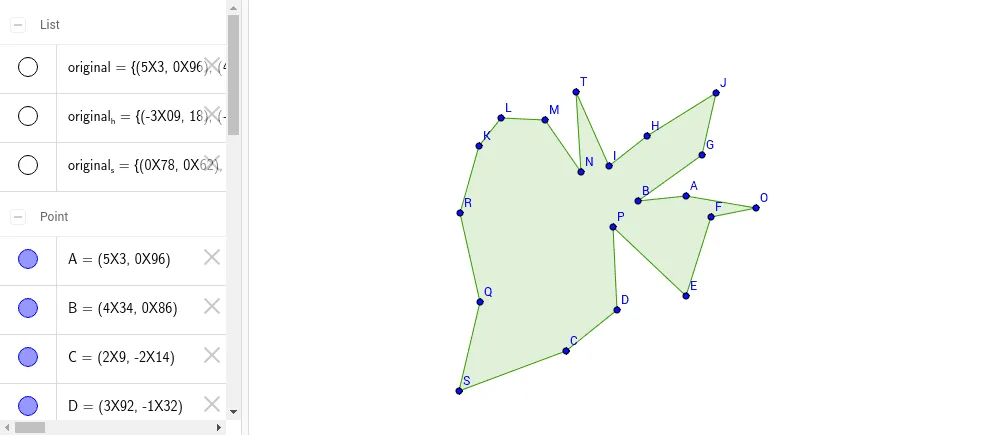
This GeoGebra example demonstrates how to take an unordered list of plane points, sort them according to a geometric rule, and connect them in sequence to form a simple polygon with no self-intersections. The construction illustrates core concepts in computational and Euclidean geometry, including polygon simplicity, self-intersection avoidance, point-set ordering, and closed polygonal chains. Built with GeoGebra commands Sort, Sequence, and Polygon, the example uses objects A through Z along with auxiliary objects such as original, Z, original_h, original_s, and the resulting poly1. It is suitable for high school geometry, undergraduate analytic geometry, and GeoGebra dynamic construction tutorials, offering a concrete model for teaching simple polygon construction and basic computational geometry algorithms.
GeoGebra Commands & Parameters
Sort(Sequence[(arg(Element[original, i] - Z), i), i, 1, Length[original]]) → original_hSequence(Element[original, y(Element[original_h, i])], i, 1, Length[original]) → original_sPolygon(original_s) → poly1, , , , , , , , , , , , , , , , , , , ,
AI Drawing Prompt Reference
Draw a simple polygon formed from an unordered set of plane points, where the connecting order is determined by sorting points based on their polar angle around a reference point. Place twenty-six labeled points randomly, compute each point's angle relative to a central reference, sort them by increasing angle, then connect them sequentially and close the chain to form a non-self-intersecting polygon. Show the original scattered points, the sorted connecting path, and the final polygon outline, emphasizing that the polygon has no self-intersections.
The prompt above was compiled from the original drawing commands and is for reference only.