
Constructing a Rhombicosidodecahedron (V=60) via Trisection of 9th-Order Segment
Loading the math board and drawing, please wait…
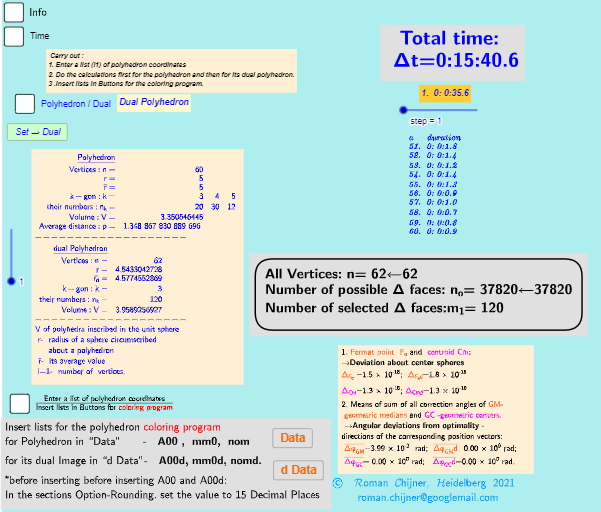
This example demonstrates how to construct a Rhombicosidodecahedron (with volume parameter V=60) from a biscribed Pentakis Dodecahedron by applying trisection to its 9th-order segments (Variant2). The construction showcases 3D solid geometry with strong symmetry: reflection/placement rules, relationships to circumcircle or circumscribed-circle features, and dilation (scaling) to control the geometry’s size. Key mathematical ideas include the parametric subdivision of geometric edges/segments, mapping discrete parameters to vertices/edges of a higher-complex polyhedron, and computing volume-related quantities to confirm the target metric. In GeoGebra, the workflow leverages commands and data objects indicated in the construction summary: Text for annotations, Sequence for generating parameter lists, If and Div for conditional logic and segmentation, Length for measurements, Element/IndexOf/First to retrieve indexed values from constructed lists, and TableText to present computed/aggregated results. Volume/scale variables such as Volsphere, Vol, Vol_r, and Volsphere_d are used to organize and validate the final construction. Suitable for advanced high school or university-level solid geometry, symmetry/transformations, and GeoGebra parametric modeling practice.
GeoGebra Commands & Parameters
Text("" + p) → txt_pSum(Flatten[Sequence[Append[Sequence[Element[txt_p, i], i, m01(k), m02(k)], " "], k, 1, 5]]) → txtUm1If(bu0, A00, A00d) → A00_0Length(A00_0) → nLength(l2) → läl2Sequence(sgn(Determinant[{Element[A00_0, i1] - Element[A00_0, j], Element[A00_0, i2] - Element[A00_0, j], Element[A00_0, i3] - Element[A00_0, j]}]), j, 1, n) → l01Length(A00d) → zzzSum(Zip[(T * F), T, SysTimeAkt1, F, {1, 1000, 60000, 3600000, 86400000}]) → TimeAbs1Sum(Zip[(T * F), T, SysTimeAkt2, F, {1, 1000, 60000, 3600000, 86400000}]) → TimeAbs2Div(TimeRelab, 3600) → HDiv(TimeRelab - (H * 3600), 60) → MElement(ZwZeit, step) → text10TableText({Append["a duration", Last[ZwZeit, Min[10, Length[ZwZeit]]]]}, "v") → text2cLength(A00) → lm1If(Length[Unique[l01 \ {0}]] ≟ 1, 7, -7) → a7Sum(Zip[(T * F), T, SysTimeAkt0, F, {1, 1000, 60000, 3600000, 86400000}]) → TimeAbs0Div(TimeRelab0, 3600) → H0Div(TimeRelab0 - (H0 * 3600), 60) → M0Text("" + (TimeRelab0 - (H0 * 3600) - (M0 * 60))) → S0aText("" + (TimeRelab - (H * 3600) - (M * 60))) → SIndexOf(".", S) → indexIndexOf(".", S0a) → indexaFirst(S, index + 1) → txtSFirst(S0a, indexa + 1) → txtS0aIf(bu0, " ", "d") → txtbuoMax(Length[A00], Length[A00d]) → maxläElement(A00, 24) → m11TableText({{"\underline{Polyhedron}"}, Append["Vertices: n=", {Length[A00]}], Append["r=", {r}], Append["\bar{r}=", {r_m}], Append["k-gon : k=", mm5a], Append["their\; numbers: n_k=", mm7a], Append["Volume: V=", {Vol_r}], Append["Average\; distance: p=", {txtUm1}]}, "hr ") → text7TableText({{"\underline{dual\;Polyhedron}"}, Append["Vertices: n=", {Length[A00d]}], Append["r=", {r_d}], Append[" \bar{r_d}= ", {r_md}], Append["k-gon : k=", mm5ad], Append["their\; numbers: n_k=", mm7ad], Append["Volume: V=", {Vold_r}]}, "hr ") → text20
AI Drawing Prompt Reference
Construct a Rhombicosidodecahedron with volume parameter V=60, featuring 60 vertices. Generate this polyhedron by trisecting 9th-order segments of a biscribed Pentakis Dodecahedron. Display the symmetry properties including reflection transformations and placement rules, along with circumcircle relationships. Include scaling via dilation to control size. Compute and annotate: total vertex count n, average distance p, the distribution of k-gon faces with their quantities, and the final computed volume.
The prompt above was compiled from the original drawing commands and is for reference only.