
Constructing a Rhombicosidodecahedron (V=60) from a Biscribed Pentakis Dodecahed
Loading the math board and drawing, please wait…
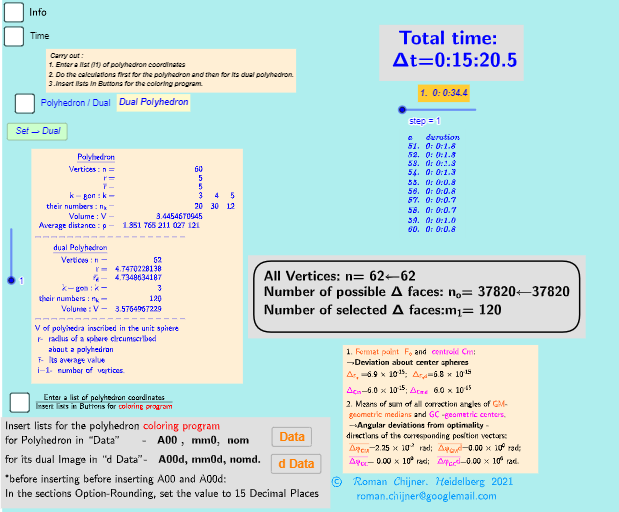
This example demonstrates a step-by-step construction of the Rhombicosidodecahedron (V=60) starting from a biscribed Pentakis Dodecahedron, specialized to the case where the 8th-order segments are trisected (Variant1). It highlights how discrete segment indexing and conditional geometry rules can drive an exact 3D solid construction. Key mathematical ideas include solid-geometry construction, circumscribed/inscribed circle principles, symmetry-driven segmentation, and metric verification via lengths and volume-related quantities (e.g., Volsphere and Volsphere_d). In GeoGebra, the construction uses commands such as Text/TableText for labeling, Sequence/Div/Element/IndexOf for generating and selecting discretized parameters and segment elements, Length for measuring geometric quantities (r and derived lengths), and If for switching construction logic across trisection cases. The presence of computed volume-like variables (Vol, Vol_r, A00, A00d) supports validation of the geometric configuration. Suitable for advanced high-school enrichment, contest preparation, and early-university courses on spatial geometry and computational geometry visualization.
GeoGebra Commands & Parameters
Text("" + p) → txt_pSum(Flatten[Sequence[Append[Sequence[Element[txt_p, i], i, m01(k), m02(k)], " "], k, 1, 5]]) → txtUm1If(bu0, A00, A00d) → A00_0Length(A00_0) → nLength(l2) → läl2Sequence(sgn(Determinant[{Element[A00_0, i1] - Element[A00_0, j], Element[A00_0, i2] - Element[A00_0, j], Element[A00_0, i3] - Element[A00_0, j]}]), j, 1, n) → l01Length(A00d) → zzzSum(Zip[(T * F), T, SysTimeAkt1, F, {1, 1000, 60000, 3600000, 86400000}]) → TimeAbs1Sum(Zip[(T * F), T, SysTimeAkt2, F, {1, 1000, 60000, 3600000, 86400000}]) → TimeAbs2Div(TimeRelab, 3600) → HDiv(TimeRelab - (H * 3600), 60) → MElement(ZwZeit, step) → text10TableText({Append["a duration", Last[ZwZeit, Min[10, Length[ZwZeit]]]]}, "v") → text2cLength(A00) → lm1If(Length[Unique[l01 \ {0}]] ≟ 1, 7, -7) → a7Sum(Zip[(T * F), T, SysTimeAkt0, F, {1, 1000, 60000, 3600000, 86400000}]) → TimeAbs0Div(TimeRelab0, 3600) → H0Div(TimeRelab0 - (H0 * 3600), 60) → M0Text("" + (TimeRelab0 - (H0 * 3600) - (M0 * 60))) → S0aText("" + (TimeRelab - (H * 3600) - (M * 60))) → SIndexOf(".", S) → indexIndexOf(".", S0a) → indexaFirst(S, index + 1) → txtSFirst(S0a, indexa + 1) → txtS0aIf(bu0, " ", "d") → txtbuoMax(Length[A00], Length[A00d]) → maxläElement(A00, 24) → m11TableText({{"\underline{Polyhedron}"}, Append["Vertices: n=", {Length[A00]}], Append["r=", {r}], Append["\bar{r}=", {r_m}], Append["k-gon : k=", mm5a], Append["their\; numbers: n_k=", mm7a], Append["Volume: V=", {Vol_r}], Append["Average\; distance: p=", {txtUm1}]}, "hr ") → text7TableText({{"\underline{dual\;Polyhedron}"}, Append["Vertices: n=", {Length[A00d]}], Append["r=", {r_d}], Append[" \bar{r_d}= ", {r_md}], Append["k-gon : k=", mm5ad], Append["their\; numbers: n_k=", mm7ad], Append["Volume: V=", {Vold_r}]}, "hr ") → text20
AI Drawing Prompt Reference
Starting from a biscribed pentakis dodecahedron, construct a rhombicosidodecahedron with 60 vertices. Trisect the 8th-order segments, using discrete indexing and conditional geometry rules to drive an exact 3D solid construction. The figure incorporates circumscribed and inscribed circle principles, symmetry-driven segmentation, and metric verification via lengths and volume-related quantities (e.g., sphere volume). Finally, display the polyhedron and its dual, listing vertices, radii, face types and counts, and volumes in a table.
The prompt above was compiled from the original drawing commands and is for reference only.