
Connecting Volumes of Pyramids and Prisms Using Visual Models
Loading the math board and drawing, please wait…
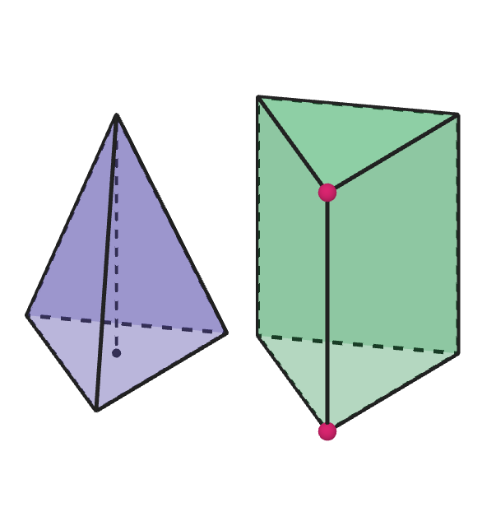
This activity explores the relationship between the volumes of pyramids and prisms using visual models. The key mathematical concepts involve volume, base area, and height. Construction uses GeoGebra commands such as Segment, Point, Pyramid, Prism, etc. Suitable for middle school mathematics education to help students understand volume calculations in solid geometry.
GeoGebra Commands & Parameters
Segment((-1.5, 3), (1.5, 3)) → segmCPoint(segmC) → CSegment(C + (0, 0, 0.1), HM) → hPriPoint(yAxis) → TSequence(Rotate[C, ((t * 2) * pi / n), T], t, 1, n) → vertPolygon(vert) → polyBaseRay(C + (0, 0, 0.1), (x(C), y(C), 40)) → hPoint(hPri) → HSegment(C, H) → heiPrism(polyBase, hei) → a, D, face3, face4, face5, face6, face7, face2, face15, faceDEFGIJK, edge1, edge2, E, edge3, edge4, edge5, edge6, edge7, edge15, edgeDE, edgeEF, edgeFG, edgeGI, F, edgeIJ, edgeJK, edgeDK, edge16, G, I, J, K, L, face1Vector(A, T) → uTranslate(polyBase, Vector[(tra * u)]) → pyrBasePyramid(pyrBase, hei) → b, B, edge8, edge9, edge10, edge11, edge12, edge13, edge14, edge17, face8, face10, face11, face12, face13, face14, face9, face16Centroid(pyrBase) → MSegment(V, M) → hPirVector(C, H) → vTranslate(vert, v) → vertUpVertex(pyrBase) → vertPir_{1}, vertPir_{2}, vertPir_{3}, vertPir_{4}, vertPir_{5}, vertPir_{6}, vertPir_{7}, vertPir_{8}Sequence((-8.6, 3.2) + (t / 6 * ((-4.1, 3.2) - (-8.6, 3.2))), t, 1, 6) → fakeCursorGridElement(fakeCursorGrid, n - 2) → PSLIPyramid(pyrBase, hei) → bBlack, P, spigolo1, spigolo2, spigolo3, edge18, edge19, edge20, edge21, edge22, faccia1, faccia3, faccia2, face17, face18, face19, face20, face21Prism(polyBase, hei) → priBlack, Q, faccia6, faccia5, face22, face23, face24, face25, face26, facciaQRS, spigolo4, spigolo5, R, spigolo6, edge23, edge24, edge25, edge26, edge27, spigoloQR, spigoloRS, spigoloQS, edge28, S, edge29, edge30, edge31, edge32, U, W, Z, A_1, B_1, faccia4Corner(5) → AppSize
AI Drawing Prompt Reference
Draw a figure consisting of a prism and a pyramid. The base of the prism is a polygon, and the base of the pyramid is the same as the prism's base. The figure includes a rotated polygon and a translated polygon as the base. Also, draw the lateral surfaces of the prism and pyramid, along with their centroids and vertices. The construction order starts from the base, then adds the prism and pyramid, and finally determines the centroid and vertex positions.
The prompt above was compiled from the original drawing commands and is for reference only.