
Conic Sections Demo by Bernat
Loading the math board and drawing, please wait…
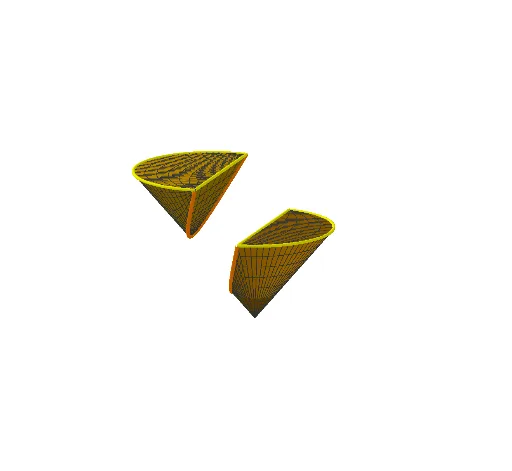
This example demonstrates various conic sections formed by intersections between a cone and different geometric elements like lines and planes. It involves core concepts such as cones, sections, coordinate geometry, and vector operations. GeoGebra commands like Line, Surface, Intersect, and OrthogonalPlane are used in construction. Suitable for high school students and math enthusiasts exploring conic geometry and section transformations.
GeoGebra Commands & Parameters
Line(A, B) → fOrthogonalPlane(A, f) → aOrthogonalVector(a) → uPointIn(a) → DSurface(((m * u) * cos(v)), ((m * u) * sin(v)), u, u, -10, 10, v, 0, (2 * π)) → conIntersect(ff, gg, 0, (2 * π)) → G, KCurveCartesian(con(ff(t), t), t, 0, x(G)) → b_1Mirror(G, q) → G'CurveCartesian(con(ff(t), t), t, x(G'), (2 * π)) → b_2CurveCartesian(con(10, t), t, 0, (2 * π)) → nLine(C, J) → gCurveCartesian(con(10, t), t, 0, x(G)) → n_1Mirror(G, g) → FCurveCartesian(con(ff(t), t), t, 0, (2 * π)) → bInfiniteCone((0, 0, 0), Vector[(0, 0, 1)], α) → cLine((0, 0, 0), (0, 0, 1)) → hCircle(A, 1, Vector[(0, 1, 0)]) → dIf(β ≥ π / 2, H, I) → P_bIntersectPath(a, c) → k_1CurveCartesian(con(z(P_b), t), t, 0, (2 * π)) → jSurface(con((k * ff(t)) + ((1 - k) * z(P_b)), t), k, 0, 1, t, 0, (2 * π)) → iSurface((k * b(t)) + ((1 - k) * b(t + π)), k, 0, 1, t, 0, π) → lCircle(zAxis, P_b) → pSurface(((m * u) * cos(v)), ((m * u) * sin(v)), u, u, 0, z(P_b), v, 0, (2 * π)) → con2Intersect(ff, gg, (-92.56337323042047, 9.999999999999849)) → EIf(z(P_b) < 10, x(G), (2 * π)) → limSurface(con((k * ff(t)) + ((1 - k) * 10), t), k, 0, 1, t, 0, x(G)) → i_1Surface(con((k * z(P_b)) + ((1 - k) * 10), t), k, 0, 1, t, 0, (2 * π)) → tMidpoint(P_1, P_2) → P_3CurveCartesian(P_1 + (k * (P_3 - P_1)), k, 0, 1) → n_3CurveCartesian(P_3 + (k * (P_2 - P_3)), k, 0, 1) → n_4Surface((k * n_1(t)) + ((1 - k) * n_3((aux_2 * t) + 1)), k, 0, 1, t, 0, x(G)) → vSurface((k * n(t)) + ((1 - k) * n(t + π)), k, 0, 1, t, 0, π) → wCurveCartesian(con(10, t), t, x(G), x(G')) → n_5CurveCartesian(P_1 + (k * (P_2 - P_1)), k, 0, 1) → n_6Circle(zAxis, I) → p'Cone(p', (-z(I))) → con3, c_1, d_1Line(P_4, P_3) → f_1CurveCartesian(con(z(I), t), t, 0, x(G)) → j'_1CurveCartesian(con(z(I), t), t, x(F), (2 * π)) → j'_2Surface(((m * u) * cos(v)), ((m * u) * sin(v)), u, u, 0, z(I), v, 0, (2 * π)) → con4Line(P_3, P_4) → f'_1CurveCartesian(con(z(I), t), t, x(G), x(G')) → j'_3Surface((k * b_1(t)) + ((1 - k) * j'_1(t)), k, 0, 1, t, 0, x(G)) → v_2Translate(i_1, Vector[(k * e)]) → t_1Translate(n_1, Vector[(k * e)]) → ct_3Mirror(n_1, g) → n_2Translate(n_2, Vector[(k * e)]) → ct_4Translate(n_3, Vector[(k * e)]) → ct_5Translate(b_1, Vector[(k * e)]) → ct_1Translate(n_4, Vector[(k * e)]) → ct_6Translate(t, Vector[(k * e)]) → t'_2Translate(i, Vector[(k * e)]) → t'_3Translate(w, Vector[(k * e)]) → t'_4Translate(n, Vector[(k * e)]) → ct'_1Translate(b, Vector[(k * e)]) → ct'_2Translate(l, Vector[(k * e)]) → t'_5Surface(con((k * ff(t)) + ((1 - k) * 10), t), k, 0, 1, t, x(G'), (2 * π)) → i_2Surface((k * n_5(t)) + ((1 - k) * n_6((aux_3 * t) + aux_4)), k, 0, 1, t, x(G), x(G')) → v_1Surface((k * n_5(t)) + ((1 - k) * j'_3(t)), k, 0, 1, t, x(G), x(G')) → v_4Surface((k * b_1(t)) + ((1 - k) * b_2((aux_1 * t) + (2 * π))), k, 0, 1, t, 0, x(G)) → l_1Surface((k * b_2(t)) + ((1 - k) * j'_2(t)), k, 0, 1, t, x(G'), (2 * π)) → v_3Translate(b_2, Vector[(k * e)]) → ct_2CurveCartesian(con(z(I), t), t, 0, (2 * π)) → j'Surface((k * b(t)) + ((1 - k) * j'(t)), k, 0, 1, t, 0, (2 * π)) → oTranslate(l_1, Vector[(k * e)]) → t_2Mirror(v, f_1) → v'Translate(v, Vector[(k * e)]) → t_3Translate(v', Vector[(k * e)]) → t_4Translate(i_2, Vector[(k * e)]) → t_5IntersectPath(a, c) → e_1Focus(e_1) → L, MAxes(e_1) → g_1, h_1