
Conic Intersection Demo
Loading the math board and drawing, please wait…
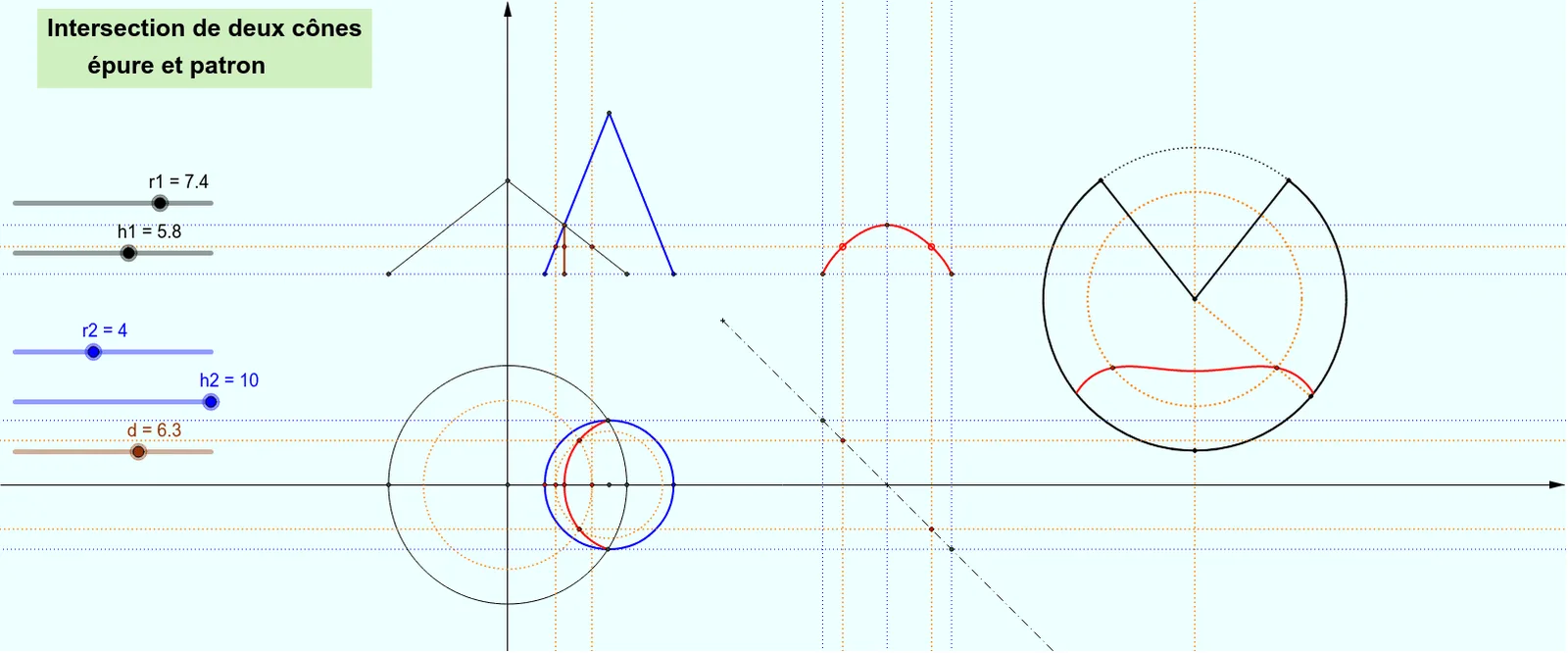
This example demonstrates the intersection of cones. It involves core mathematical concepts such as cones, intersection, percentages, quadratic functions, definite integrals, slope, and arithmetic. The construction utilizes GeoGebra commands/objects like Intersect, Circle, Point, OrthogonalLine, Segment, Rotate, Angle, Ray, Locus, Mirror, and CircleArc. Suitable for high school and above, ideal for teaching solid geometry and calculus.
GeoGebra Commands & Parameters
Intersect(xAxis, yAxis) → ACircle(A, r1) → cCircle(A, d) → eIntersect(e, xAxis, 2) → BCircle(B, r2) → fPoint(yAxis) → COrthogonalLine(C, yAxis) → gIntersect(c, xAxis) → D, EIntersect(f, xAxis) → F, GOrthogonalLine(D, xAxis) → hOrthogonalLine(F, xAxis) → iOrthogonalLine(E, xAxis) → jOrthogonalLine(B, xAxis) → kOrthogonalLine(G, xAxis) → lIntersect(g, h) → HIntersect(g, i) → IIntersect(g, j) → JIntersect(g, k) → KIntersect(g, l) → LCircle(C, h1) → pIntersect(p, yAxis, 2) → MCircle(K, h2) → qIntersect(q, k, 2) → NSegment(M, H) → mSegment(M, J) → nSegment(N, I) → rSegment(N, L) → sPoint(xAxis) → ORotate(A, (-(45°)), O) → A'Angle(A', O, A) → αRay(A', O) → tPoint(t) → PRay(P, O) → aIntersect(c, f) → Q, R, ,OrthogonalLine(Q, yAxis) → bOrthogonalLine(R, yAxis) → f_1Intersect(a, b) → SIntersect(f_1, a) → TOrthogonalLine(S, xAxis) → g_1OrthogonalLine(T, xAxis) → h_1Intersect(g, g_1) → UIntersect(g, h_1) → VIntersect(n, r) → WOrthogonalLine(W, g) → i_1Intersect(i_1, xAxis) → ZOrthogonalLine(W, yAxis) → j_1OrthogonalLine(O, xAxis) → k_1Intersect(j_1, k_1) → A_1Intersect(g, i_1) → B_1Segment(W, B_1) → l_1Point(l_1) → C_1OrthogonalLine(C_1, yAxis) → m_1Intersect(m_1, r) → D_1Intersect(m_1, n) → E_1OrthogonalLine(E_1, m_1) → n_1OrthogonalLine(D_1, m_1) → p_1Intersect(p_1, xAxis) → F_1Intersect(n_1, xAxis) → G_1Circle(A, G_1) → c_1Circle(B, F_1) → d_1Intersect(d_1, c_1) → H_1, I_1, ,OrthogonalLine(I_1, yAxis) → q_1OrthogonalLine(H_1, yAxis) → r_1Intersect(q_1, a) → J_1Intersect(r_1, a) → K_1OrthogonalLine(J_1, xAxis) → s_1OrthogonalLine(K_1, xAxis) → t_1Intersect(m_1, s_1) → L_1Intersect(m_1, t_1) → M_1Locus(L_1, C_1) → lieu1Locus(M_1, C_1) → lieu2OrthogonalLine(N_1, xAxis) → a_1Circle(N_1, a1) → e_1Intersect(e_1, a_1, 1) → O_1Rotate(O_1, α1, N_1) → P_1Angle(O_1, N_1, P_1) → βMirror(P_1, a_1) → Q_1CircleArc(N_1, Q_1, P_1) → c_2Segment(N_1, P_1) → b_1Segment(N_1, Q_1) → f_2Locus(I_1, C_1) → lieu3Locus(H_1, C_1) → lieu4CircleArc(A, G_1, I_1) → arcSegment(M, E_1) → aiCircle(N_1, ai) → d_2Rotate(O_1, (360° * arc / ((π * ai))), N_1) → R_1Angle(O_1, N_1, R_1) → γSegment(N_1, R_1) → g_2Intersect(d_2, g_2, 1) → S_1Locus(S_1, C_1) → lieu5Mirror(S_1, a_1) → T_1Locus(T_1, C_1) → lieu6