
Congruent Triangles Exercise 4
Loading the math board and drawing, please wait…
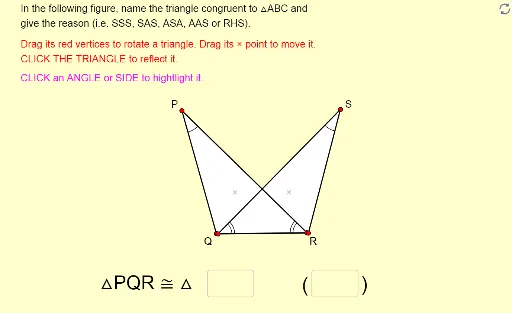
This example demonstrates how to name congruent triangles and the reasons for their congruence. Users can move, rotate, and reflect the triangles. Using GeoGebra commands like Polygon, Vector, Angle, etc., the dynamic exploration of congruent triangles' properties is facilitated. Suitable for junior high school geometry learning.
GeoGebra Commands & Parameters
Polygon(A, B, C) → poly1, c, a, bVector(P, A) → uVector(P, B) → vVector(P, C) → wPolygon(A_1, B_1, C_1) → poly1_1, c_1, a_1, b_1Vector(P_1, A_1) → u_1Vector(P_1, B_1) → v_1Vector(P_1, C_1) → w_1Angle(B, A, C) → αAngle(A, C, B) → βAngle(A_1, C_1, B_1) → γAngle(B_1, A_1, C_1) → δIntersect(Line[X_0, Rotate[Y_0, Ang_A, X_0]], Line[Y_0, Rotate[X_0, (-(180° - Ang_C - Ang_A)), Y_0]]) → Z_0Polygon(X_0, Y_0, Z_0) → poly2, z_0, x_0, y_0Textfield(text13) → Ans1Textfield(text14) → Ans2Segment(D, E) → rMidpoint(Segment[Intersect[Circle[A, r], b], Intersect[Circle[A, r], c]]) → FMidpoint(Segment[Intersect[Circle[C, r], a], Intersect[Circle[C, r], b]]) → GMidpoint(Segment[Intersect[Circle[A_1, r], b_1], Intersect[Circle[A_1, r], c_1]]) → HMidpoint(Segment[Intersect[Circle[C_1, r], a_1], Intersect[Circle[C_1, r], b_1]]) → IAngle(A_1, B_1, C_1) → εAngle(C, B, A) → ζMidpoint(Segment[Intersect[Circle[B, r], a], Intersect[Circle[B, r], c]]) → JMidpoint(Segment[Intersect[Circle[B_1, r], a_1], Intersect[Circle[B_1, r], c_1]]) → KRotate(Polygon[Mirror[X_0, x = 0], Mirror[Y_0, x = 0], Mirror[Z_0, x = 0]], 225°, (2, 0)) → poly3Vertex(poly3, 1) → X_1Vertex(poly3, 2) → Y_1Vertex(poly3, 3) → Z_1