
Congruent Segments Quick Exploration
Loading the math board and drawing, please wait…
In collections
Congruence (CO) Cluster
Congruence (Vol 1)
Congruence (Vol 1) Over 80 Resources
CCSS High School: Geometry (Congruence) Volume 1 S N ATTAR
Geometry (Congruence) Volume 1
CCSS High School: Geometry (Congruence) Volume 1
CCSS High School: Geometry (Congruence) Volume 1
CCSS High School: Geometry (Congruence) Volume 1
CCSS High School: Geometry (Congruence) Volume 1
CCSS High School: Geometry (Congruence) Volume 1
CCSS High School: Geometry (Congruence) Volume 1
CCSS High School: Geometry (Congruence) Volume 1
CCSS High School: Geometry (Congruence) Volume 1
CCSS High School: Geometry (Congruence) Volume 1
CCSS High School: Geometry (Congruence) Volume 1
CCSS High School: Geometry (Congruence) Volume 1
CCSS High School: Geometry (Congruence) Volume 1
Points, Lines, Planes, and Angles
Points, Lines, Planes, and Angles
Geometry: Introductory Definitions, Postulates, Theorems
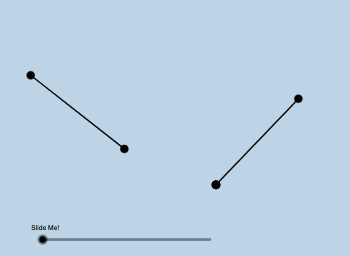
This example dynamically illustrates the transformational geometry definition of segment congruence using rotations and translations. It covers core concepts like congruence, rotation, translation, and vectors. Constructed with commands like Segment, Rotate, Translate, and Vector, it is suitable for middle school and above to understand transformation geometry and congruence.
GeoGebra Commands & Parameters
Segment(A, B) → aPoint(Circle[C, a]) → DSegment(C, D) → bDilate(A, If[0 < c ≤ 1, 1 - c, 0], D) → A'Vector(A, A') → uLine(A, D) → dVector(A, D) → vTranslate(A, v) → A'_2Translate(B, v) → B'_1Segment(A'_2, B'_1) → a'_1Angle(C, D, B'_1) → αTranslate(A, u) → A'_1Translate(B, u) → B'Segment(A'_1, B') → a'Rotate(A'_1, If[1 < c ≤ 2, ((-(c - 1)) * α), (-α)], A'_1) → ERotate(B', If[1 < c ≤ 2, ((-(c - 1)) * α), (-α)], A'_1) → B''Segment(E, B'') → a''Circle(D, 1) → eIntersect(e, a'_1, 1) → FIntersect(e, b, 1) → GIntersect(e, a'_1, 1) → HIntersect(e, a'', 1) → ICircleSector(D, I, H) → f
AI Drawing Prompt Reference
Draw two line segments where the first segment has a point on it. Use this point as the center to draw a circle intersecting the first segment at another point, forming a second segment. Create rotated and translated copies of the second segment based on the first segment using rotation and vector translation. Utilize intersections of a circle with the segments to draw a sector, illustrating the geometric transformation relationships of rotation and translation.
The prompt above was compiled from the original drawing commands and is for reference only.