
Confidence Interval for a Single Mean - Interactive Demo
Loading the math board and drawing, please wait…
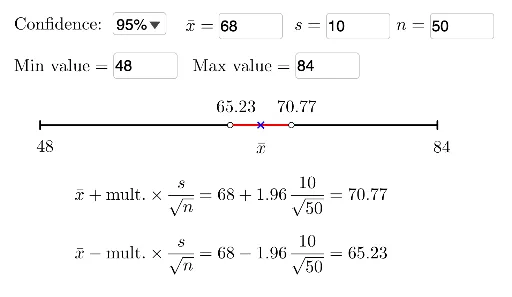
This GeoGebra example provides an interactive demonstration of constructing a confidence interval for a single population mean, allowing users to adjust sample size, standard deviation, and confidence level to see how the interval changes. The core mathematical concepts include sample mean, standard error, critical values from the t-distribution, confidence level, and the lower/upper bounds of the interval. The construction uses commands such as IndexOf, Segment, and Textfield to create input boxes and dynamic text, with objects like sdev, n, conf, xbar, margin, left, right, ciL, and ciR to compute and display the interval endpoints in real time. A visual representation on a number line helps illustrate the interval width. This resource is suitable for high school or introductory college statistics courses, aiding students in understanding the relationship between confidence level, sample size, and interval precision, as well as practicing statistical simulation and dynamic visualization with GeoGebra.
GeoGebra Commands & Parameters
IndexOf(SelectedElement[conf], conf) → indSegment((0, 0), (1, 0)) → gTextfield(xbar) → InputBox1Textfield(n) → InputBox2Segment((0, -0.01), (0, 0.01)) → hSegment((1, -0.01), (1, 0.01)) → iTextfield(sdev) → InputBox3Textfield(min) → InputBox4Textfield(max) → InputBox5Segment((leftS, 0), (rightS, 0)) → f
AI Drawing Prompt Reference
Create an interactive demonstration showing how to construct a confidence interval for a single population mean. Include a number line with input boxes for sample mean and sample size at the top, and for standard deviation and confidence level at the bottom. Dynamically display the lower and upper bounds of the confidence interval, marking them on the number line. Also show the sample mean, standard error, critical values, and the width of the interval to illustrate the relationship between confidence level, sample size, and interval precision.
The prompt above was compiled from the original drawing commands and is for reference only.