
Cones & Pyramids: A Dynamic 3D Geometry Exploration
Loading the math board and drawing, please wait…
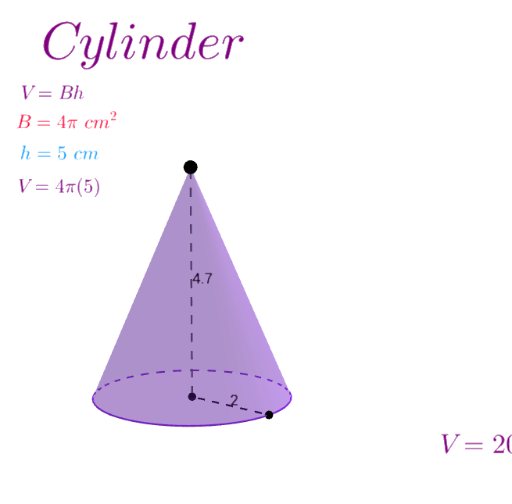
① This GeoGebra example dynamically demonstrates the construction and relationship between cones and pyramids, visualizing how these 3D solids are formed from their bases and apex. ② Core mathematical concepts include solid geometry definitions of cones and pyramids, base, apex, slant height, height, and volume formulas, with additional connections to complex numbers, integrals, and equations as extended topics. ③ Construction highlights: based on the summary, it uses commands such as Segment, Cylinder, Intersect, Point, and Cone, along with multiple points (A, B, C, D, E), segments (a, b, c, d, e, f, g, h, i), text objects (text1 to text10), and variables (n, v, j), enabling interactive manipulation of the solids. ④ Suitable for upper middle school and high school students (e.g., introductory geometry, high school solid geometry) to understand cone and pyramid structures, and also useful for teachers as a classroom demonstration or for student self-exploration to enhance spatial reasoning.
GeoGebra Commands & Parameters
Segment(D, C) → gCylinder(C, D, 2) → a, c, d, bIntersect(c, b) → A, , ,Point(c) → BSegment(C, B) → fCone(c, -4.699272805127201) → e, h, iPoint(h) → ESegment(E, C) → j