
Cone and Cylinder Volume Relationship Demo
Loading the math board and drawing, please wait…
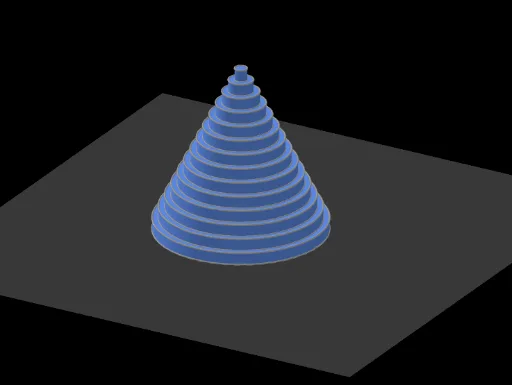
This example dynamically demonstrates the volume relationship between a cone and a cylinder, visually showing the mathematical connection between their volumes. Core concepts include volume calculation formulas, function relationships, ellipse, expected value, and hypothesis testing. GeoGebra commands and objects like Sequence, Sum, Segment, Point, and Midpoint are used in the construction. Suitable for high school and above learners to understand solid geometry and calculus concepts related to volume and function applications.
GeoGebra Commands & Parameters
Sequence(Cylinder[(0, 0, (i * h / n)), (0, 0, ((i + 1) * h / n)), ((n - i) * R / n)], i, 0, n - 1) → liste2Sum(liste2) → aSequence(Cylinder[(0, 0, (i * h / n)), (0, 0, ((i + 1) * h / n)), ((n - i) * R / n)], i, 0, n - 1) → liste1Segment(A, O) → bPoint(liste1) → CPoint(b) → ESegment(D, E + (0, 0, 0.1)) → cMidpoint(c) → BSegment(F, G) → dMidpoint(d) → HSegment(G, I) → eSegment(F, D) → fSegment(Z, A_1) → g
AI Drawing Prompt Reference
Create a 3D solid geometry illustration demonstrating the volume relationship between a cone and a cylinder. The cone is approximated by a stack of thin cylindrical layers, with radii decreasing linearly from base to apex. A vertical segment connects the apex to the center of the base, representing the height. Several points are placed on the cone's surface and base, connected by line segments to form auxiliary lines. The composition clearly shows how the cone's volume relates to the cylinder's, suitable for educational demonstration.
The prompt above was compiled from the original drawing commands and is for reference only.