
Composition of 3 Reflections - General Position
Loading the math board and drawing, please wait…
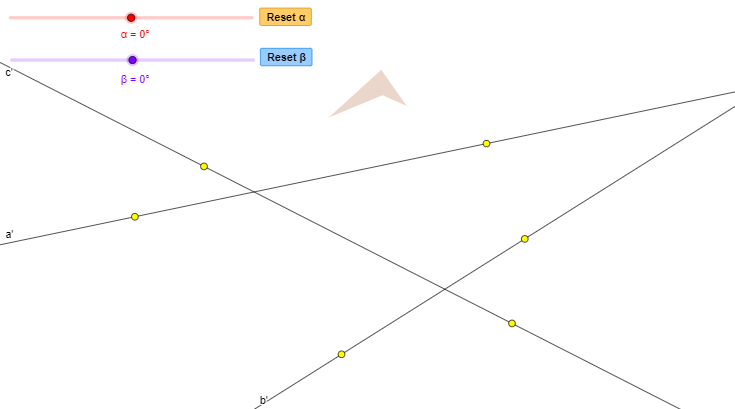
① This example demonstrates the effect of applying three successive reflections (mirror images) about three different lines in general position to a planar figure, showing the intermediate and final transformed shapes. ② The core mathematical concepts are reflection transformations and their composition, including properties of isometries (distance-preserving transformations), and the result that the composition of three reflections is equivalent to a rotation or a translation depending on whether the three mirror lines are concurrent or parallel. ③ Construction details: Based on the construction summary, the GeoGebra commands used include Line, Intersect, Rotate, Point, Mirror, and Polygon. The construction creates three mirror lines a, b, c, an initial polygon, and successive reflected polygons (e.g., N', O', P', etc.), with buttons (button1, button2) to control the interactive steps. ④ This is suitable for high school or early college geometry courses to understand composition of reflections, classification of isometries, and interactive construction in dynamic geometry software.
GeoGebra Commands & Parameters
Line(A, B) → aLine(C, D) → bLine(E, F) → cIntersect(b, c) → GIntersect(a, c) → HIntersect(a, b) → IRotate(c, α, G) → c'Rotate(b, α, G) → b'_1Intersect(b'_1, a) → JRotate(a, β, J) → a'Rotate(b'_1, β, J) → b'Point(a') → KIntersect(c', b') → LPoint(c') → MMirror(N, a') → N'Mirror(O, a') → O'Mirror(P, a') → P'Mirror(N', b') → N''Mirror(O', b') → O''Mirror(P', b') → P''Mirror(N'', c') → N'''Mirror(O'', c') → O'''Mirror(P'', c') → P'''Mirror(N, a') → N'_1Mirror(O, a') → O'_1Mirror(P, a') → P'_1Mirror(N'_1, b') → QMirror(O'_1, b') → RMirror(P'_1, b') → SPolygon(T, U, V, W) → poly1, t, u, v, w
AI Drawing Prompt Reference
Draw an initial polygon, then perform successive reflections about three different lines a, b, and c to generate a series of reflected polygons. First, draw lines a, b, and c, then find their intersection points G, H, and I. Next, rotate b and c around G and J to generate b' and c', then rotate a and b' around G, J, and K to generate a' and b'. After that, mirror N, O, and P to a' to generate N', O', and P', then mirror N', O', and P' to b' to generate N'', O'', and P'', and finally mirror N'', O'', and P'' to c' to generate N''', O''', and P'''.
The prompt above was compiled from the original drawing commands and is for reference only.