
Complex Number Transformation and Cube Demonstration
Loading the math board and drawing, please wait…
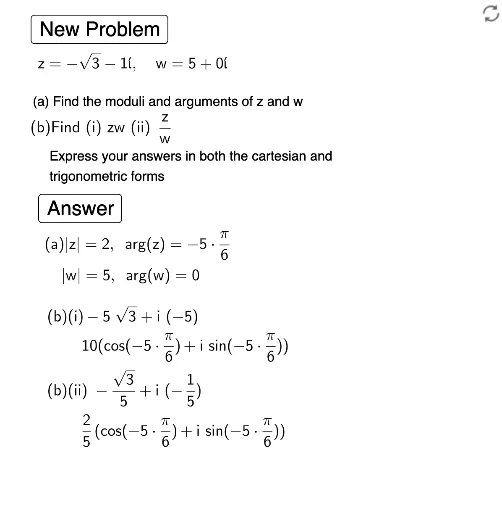
This example demonstrates the geometric translation of complex numbers and their cubic representation in a coordinate system. It involves core math concepts like complex numbers, translation, cubes, differential calculus, derivatives, and curve sketching. Constructed using commands like Sample, Element, SurdText, and objects such as l1, l2, l3, b2, button1 for interactive visualization. Suitable for high school and above mathematics education to understand the geometric meaning of complex numbers and calculus applications.
GeoGebra Commands & Parameters
Sample(l2, 2, false) → l3Element(l3, 2) → b2Element(l3, 1) → a2Element(l1, IndexOf[a2, l2]) → a3SurdText(z1) → textZ1Element(l1, IndexOf[b2, l2]) → b3SurdText(z2) → textZ2SurdText(z3) → textZ3SurdText(z4) → textZ4SurdText(α1, {π}) → textα1SurdText(α2, {π}) → textα2SurdText(α3, {π}) → textα3SurdText(α4, {π}) → textα4SurdText(abs(z1)) → a4SurdText(abs(z2)) → b4SurdText(abs(z3)) → c4SurdText(abs(z4)) → d4SurdText(real(z3), {sqrt(2), sqrt(3), sqrt(6)}) → textZ31SurdText(imaginary(z3), {sqrt(2), sqrt(3), sqrt(6)}) → textz32SurdText(real(z4), {sqrt(2), sqrt(3), sqrt(6)}) → textz41SurdText(imaginary(z4), {sqrt(2), sqrt(3), sqrt(6)}) → textz42