
Complex Number Spiral: Exploring x^n and Geometric Trajectories
Loading the math board and drawing, please wait…
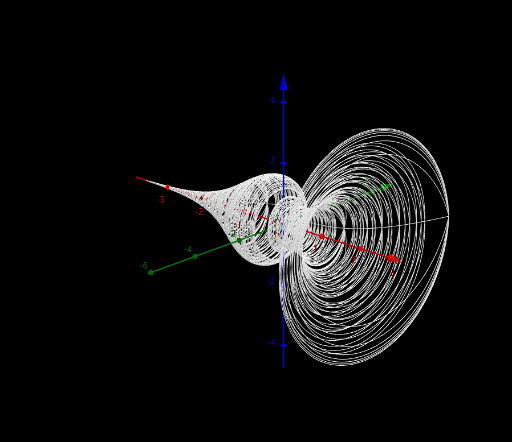
This example demonstrates the geometric construction of a complex number spiral, showing the trajectory of x^n in the complex plane. Key mathematical concepts include complex number operations, curve sketching, and parametric equations. Construction involves using GeoGebra's Sequence, Zip, and CurveCartesian commands with Ln and Spindle objects to generate the spiral. Suitable for high school students learning complex geometry or university-level mathematical analysis.
GeoGebra Commands & Parameters
Sequence(k, k, -7, 7, 1) → LnZip(CurveCartesian[t, (ℯ^((t * ln(abs(t)))) * cos((((2 * pi) * t) * k))), (ℯ^((t * ln(abs(t)))) * sin((((2 * pi) * t) * k))), t, -4, 2], k, Ln) → SpindleCurveCartesian(t, (ℯ^((t * ln(abs(t)))) * cos(((pi * t) * n))), (ℯ^((t * ln(abs(t)))) * sin(((pi * t) * n))), t, -4, 2) → a
AI Drawing Prompt Reference
Draw a complex number spiral showing the geometric trajectory of x^n in the complex plane. Use parametric equations with variable t ranging from -4 to 2, constructing a family of spiral curves in polar form where r = e^(t*ln|t|) and θ = 2π*t*k, with k taking integer values from -7 to 7, forming a spindle-like spiral cluster. Also include a curve with parameter n where the angle is π*t*n. The overall display shows spiral lines spreading from the center, illustrating the distribution pattern of complex numbers in the complex plane.
The prompt above was compiled from the original drawing commands and is for reference only.