
Completing the Square Method in Quadratic Functions
Loading the math board and drawing, please wait…
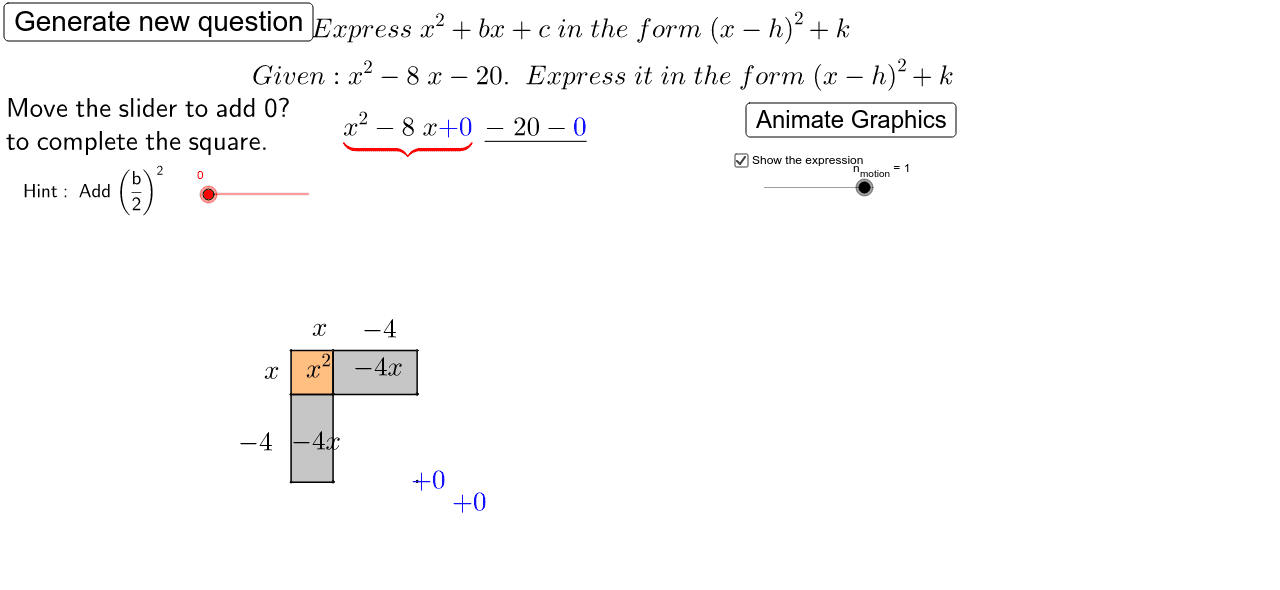
This applet demonstrates how to transform a quadratic function from the general form to the vertex form using the completing the square method. Key mathematical concepts include quadratic functions, vertex form, and the completing the square method. GeoGebra commands used include Point, Midpoint, Vector, RandomElement, and others. Suitable for middle school and above students to learn about the properties and transformations of quadratic functions.
GeoGebra Commands & Parameters
Point(yAxis) → DPoint(xAxis) → BMidpoint(B, D) → M_{BD}Vector(P_{xsquared}, M_{BD}) → u_1RandomElement({-7, -6, -5, -4, -3, -2, -1, 1, 2, 3, 4, 5, 6, 7}) → aRandom(-7, 7) → bRandom(1, 7) → cSimplify((x - a)^(2) - c^(2)) → sl1Simplify(y^(2) + b2 * y) → sr2Simplify(-((x - a)^(2) - c^(2) - x^(2) - a2 * x)) → s3Simplify(x^(2) + a2 * x) → s4Simplify((x - a)^(2)) → sl5Simplify((y - b)^(2)) → sr5Simplify(x - h) → sl6Intersect(xAxis, yAxis) → APolygon(A, B, C, D) → poly1, a_1, b_1, c_1, d_1Point(xAxis) → EPoint(xAxis) → FPolygon(E, F, G, H) → poly2, e_1, f_1, g_1, h_1Polygon(I, J, K, L) → poly3, i_1, j_1, k_1, l_1Polygon(M, N, O, P) → poly4, m_1, n_1, o_1, p_1Dilate(M, h / a, O) → M'Dilate(N, h / a, O) → N'Dilate(O, h / a, O) → O'Dilate(P, h / a, O) → P'Polygon(M', N', O', P') → poly4', m', n', o', p'Midpoint(A, B) → M_{AB}Midpoint(A, D) → M_{AD}Midpoint(E, F) → M_{EF}Midpoint(F, H) → M_{FH}Midpoint(I, L) → M_{IL}Midpoint(J, L) → M_{JL}Midpoint(N', P') → M_{NP}Translate(P_{xsquared}, Vector[n_{motion} * u_1]) → RVector(P_{xsquared}, R) → v_1Vector(P_{bx}, M_{FH}) → u_2Translate(P_{bx}, Vector[n_{motion} * u_2]) → QVector(P_{bx}, M_{JL}) → u_3Translate(P_{bx}, Vector[n_{motion} * u_3]) → SVector(P_{bx}, Q) → v_2Vector(P_{bx}, S) → v_3Dilate(M, j / a^(2), O) → M'_1Dilate(N, j / a^(2), O) → N'_1Dilate(O, j / a^(2), O) → O'_1Dilate(P, j / a^(2), O) → P'_1Polygon(M'_1, N'_1, O'_1, P'_1) → poly4'_1, m'_1, n'_1, o'_1, p'_1
AI Drawing Prompt Reference
Draw a quadratic function graph and demonstrate the transformation from the general form to the vertex form. Start by plotting points D and B on the axes, then find their midpoint M_{BD}. Construct vector u_1. Randomly select values for a, b, and c, then simplify the expressions using the completing the square method to get the vertex form of the quadratic function. Draw these functions and use translation and scaling operations to show the transformation process.
The prompt above was compiled from the original drawing commands and is for reference only.