
Completing the Square for Quadratic Equation (I)
Loading the math board and drawing, please wait…
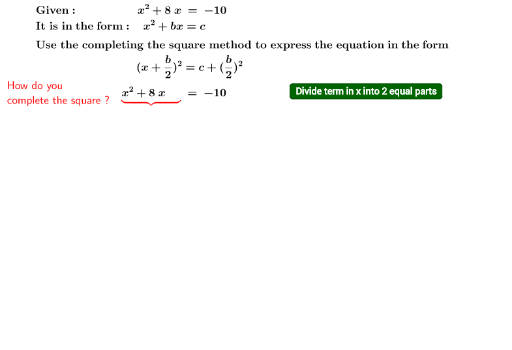
This example demonstrates the transformation of a quadratic equation into vertex form using the completing the square method, visually showing the changes in the parabola's vertex. Core mathematical concepts include quadratic equations, completing the square, vertex form, and parabolas. It utilizes commands like Point, Midpoint, RandomElement, Vector, Simplify, Intersect, Polygon, Dilate, and Translate to construct the graph dynamically, with sliders for parameter adjustment. Suitable for high school mathematics education to help students understand the application of the completing the square method and parabolic properties.
GeoGebra Commands & Parameters
Point(yAxis) → DPoint(xAxis) → BMidpoint(B, D) → M_{BD}RandomElement({-7, -6, -5, -4, -3, -2, -1, 7, 6, 5, 4, 3, 2, 1}) → aVector(P_{xsquared}, M_{BD}) → u_1Random(-7, 7) → bSimplify((x - a)^(2) - c^(2)) → sl1Simplify(y^(2) + (b2 * y)) → sr2Simplify((-((x - a)^(2) - c^(2) - x^(2) - (a2 * x)))) → s3Simplify(x^(2) + (a2 * x)) → s4Simplify((x - a)^(2)) → sl5Simplify((y - b)^(2)) → sr5Simplify(x - h) → sl6Intersect(xAxis, yAxis) → APolygon(A, B, C, D) → poly1, a_1, b_1, c_1, d_1Point(xAxis) → EPoint(xAxis) → FPolygon(E, F, G, H) → poly2, e_1, f_1, g_1, h_1Polygon(I, J, K, L) → poly3, i_1, j_1, k_1, l_1Polygon(M, N, O, P) → poly4, m_1, n_1, o_1, p_1Dilate(M, h / a, O) → M'Dilate(N, h / a, O) → N'Dilate(O, h / a, O) → O'Dilate(P, h / a, O) → P'Polygon(M', N', O', P') → poly4', m', n', o', p'Midpoint(A, B) → M_{AB}Midpoint(A, D) → M_{AD}Midpoint(E, F) → M_{EF}Midpoint(F, H) → M_{FH}Midpoint(I, L) → M_{IL}Midpoint(J, L) → M_{JL}Midpoint(N', P') → M_{NP}Translate(P_{xsquared}, Vector[(n_{motion} * u_1)]) → RVector(P_{xsquared}, R) → v_1Vector(P_{bx}, M_{FH}) → u_2Translate(P_{bx}, Vector[(n_{motion} * u_2)]) → QVector(P_{bx}, M_{JL}) → u_3Translate(P_{bx}, Vector[(n_{motion} * u_3)]) → SVector(P_{bx}, Q) → v_2Vector(P_{bx}, S) → v_3Dilate(M, j / a^(2), O) → M'_1Dilate(N, j / a^(2), O) → N'_1Dilate(O, j / a^(2), O) → O'_1Dilate(P, j / a^(2), O) → P'_1Polygon(M'_1, N'_1, O'_1, P'_1) → poly4'_1, m'_1, n'_1, o'_1, p'_1Random((-(a2 / 2)^(2)) + 1, 8) → c_R