
Complementary Surfaces (Spheres and Tears)
Loading the math board and drawing, please wait…
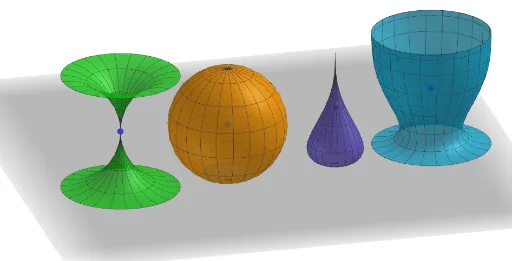
This example demonstrates the complementary surfaces of spheres and tear-drop shapes. It involves the geometric construction of spherical and irregular surfaces. Using commands like CurveCartesian, Line, and Surface, you can dynamically adjust the size and position of the spheres and tears. Suitable for high school mathematics education, particularly in coordinate geometry and solid geometry.
GeoGebra Commands & Parameters
CurveCartesian(x(O) + (R * cos(k)), y(O) + ((R * sin(k)^(1)) * sin(k / 2)), z(O), k, 0, π) → bCurveCartesian(x(O) + ((R * sin(k)) * sin(k / 2)^(r)) - R, y(O), z(O) + (R * cos(k)), k, 0, π) → cLine(O, zAxis) → fSurface(c, (2 * π), f) → dLine(A, zAxis) → gCurveCartesian(x(A) + ((R * sin(k)) * sin(k / 2)^(r)), y(A), z(A) + (R * cos(k)), k, 0, π) → eSurface(e, (2 * π), g) → hCurveCartesian(x(B) + ((R * sin(k)) * sin(k / 2)^(5 - r)), y(B), z(B) + (R * cos(k)), k, 0, π) → iLine(B, g) → jSurface(i, (2 * π), j) → kLine(C, zAxis) → lCurveCartesian(x(C) + ((R * sin(k)) * sin(k / 2)^(5 - r)) - R, y(C), z(C) + (R * cos(k)), k, 0, π) → aSurface(a, (2 * π), l) → m