
Classification of Polygons Interactive Teaching Example
Loading the math board and drawing, please wait…
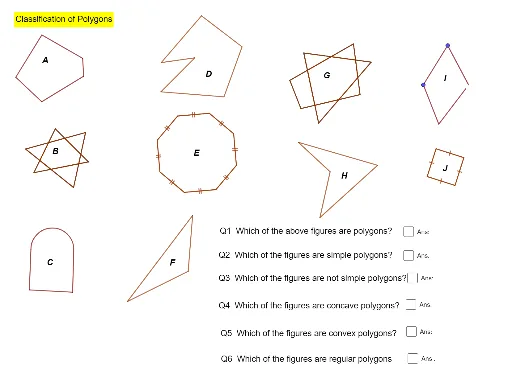
This GeoGebra activity demonstrates the classification of polygons and related terminology such as sides, vertices, and interior angles. It is designed for teacher-led discussion and quick checks of student prior knowledge. Core math concepts include polygon definitions, classification by number of sides (triangle, quadrilateral, pentagon, etc.), interior angle sums, and connections with circles (semicircles). Construction uses the Polygon command to create multiple polygons (poly1, poly2), Segment for edges, Intersect for intersection points, and Semicircle for auxiliary arcs. Objects include vertices A, B, C, D, E, F and auxiliary points G, H, I, J, K. Suitable for middle or high school geometry classes, this interactive tool supports guided inquiry, formative assessment, and self-paced exploration of polygon properties.
GeoGebra Commands & Parameters
Polygon(A, B, C, D, E, F) → poly1, a, b, c, d, e, fPolygon(G, H, I, J, K) → poly2, g, h, i, j, kSegment(M, N) → lSegment(N, L) → mSegment(L, M) → nSegment(O, P) → pSegment(P, Q) → qSegment(Q, O) → rIntersect(r, l) → RIntersect(n, r) → SIntersect(n, p) → TIntersect(p, m) → UIntersect(m, q) → VIntersect(l, q) → WPolygon(W, Q, R) → t1, r_1, w, q_1Polygon(W, N, V) → t2, v, w_1, n_1Polygon(V, P, U) → t3, u, v_1, p_1Polygon(U, L, T) → t4, t, u_1, l_1Polygon(T, O, S) → t5, s, t_1, oPolygon(S, M, R) → t6, r_2, s_1, m_1Polygon(S, T, U, V, W, R) → poly3, s_2, t_2, u_2, v_2, w_2, r_3Polygon(Z, A_1, B_1, C_1) → q1, z_1, a_1, b_1, c_1Polygon(D_1, E_1, F_1) → t7, f_1, d_1, e_1Segment(G_1, M_1) → g_1Segment(M_1, L_1) → h_1Segment(L_1, K_1) → i_1Segment(K_1, G_1) → j_1Segment(J_1, I_1) → k_1Segment(I_1, H_1) → f_2Segment(H_1, J_1) → g_2Intersect(g_2, h_1) → N_1Intersect(h_1, f_2) → O_1Intersect(i_1, f_2) → P_1Intersect(k_1, i_1) → Q_1Intersect(k_1, g_1) → R_1Intersect(g_2, g_1) → S_1Polygon(S_1, M_1, N_1) → t8, h_2, i_2, j_2Polygon(N_1, H_1, O_1) → t9, o_1, k_2, l_2Polygon(O_1, L_1, P_1) → t10, m_2, n_2, p_2Polygon(P_1, I_1, Q_1) → t11, q_2, a_2, b_2Polygon(Q_1, K_1, G_1, R_1) → q2, c_2, d_2, e_2, f_3Polygon(R_1, S_1, J_1) → t12, g_3, h_3, i_3Polygon(Q_1, P_1, O_1, N_1, S_1, R_1) → poly4, j_3, k_3, l_3, m_3, n_3, p_3Segment(T_1, U_1) → q_3Segment(U_1, V_1) → s_3Segment(V_1, W_1) → t_3Semicircle(T_1, W_1) → c_3Segment(Z_1, A_2) → a_3Segment(B_2, Z_1) → b_3Segment(B_2, C_2) → d_3Segment(D_2, C_2) → e_3Polygon(E_2, F_2, 8) → poly5, f_4, H_2, I_2, J_2, K_2, L_2, g_4, h_4, i_4, j_4, k_4, l_4, m_4, G_2Polygon(M_2, N_2, 4) → poly6, n_4, p_4, q_4, r_4, O_2, P_2