
Circles Through Fermat Point & Kiepert Hyperbola
Loading the math board and drawing, please wait…
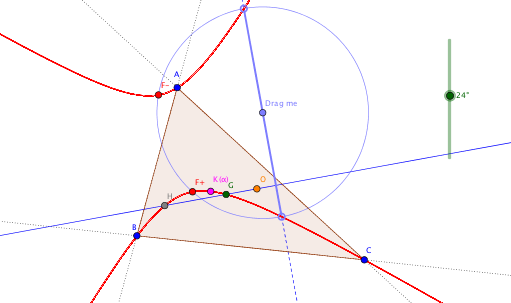
This example demonstrates the geometric relationship between circles passing through the Fermat point of a triangle and the Kiepert hyperbola, showing the intersection loci of these circles with the hyperbola. Core mathematical concepts include the Fermat point, Kiepert hyperbola, equilateral triangles, centroid, and the intersection properties of circles and hyperbolas. Construction highlights: using GeoGebra commands such as Line, Rotate, Intersect, Segment, Angle, Polygon, Locus, OrthogonalLine, Centroid, Circle, Center, LineBisector, and Point, the construction builds triangles, equilateral triangles, the Fermat point, the Kiepert hyperbola, and circles through the Fermat point, with Locus generating the trajectory. Suitable for high school and above students or geometry enthusiasts, this is useful for exploring connections between special triangle points and conic sections, and can serve as a dynamic geometry teaching demonstration.
GeoGebra Commands & Parameters
Line(A, B) → fLine(B, C) → gLine(C, A) → hRotate(h, (-α), C) → h'Rotate(h, α, A) → h'_1Intersect(h', h'_1) → YRotate(g, α, C) → g'Rotate(g, (-α), B) → g'_1Intersect(g', g'_1) → XRotate(f, α, B) → f'Rotate(f, (-α), A) → f'_1Intersect(f', f'_1) → ZSegment(B, Z) → iSegment(Z, A) → jSegment(A, Y) → kSegment(Y, C) → lSegment(C, X) → mSegment(X, B) → nAngle(A, B, Z) → βAngle(Z, A, B) → γAngle(C, A, Y) → δAngle(Y, C, A) → εAngle(X, B, C) → ζAngle(B, C, X) → ηLine(Z, C) → pLine(X, A) → qLine(B, Y) → rIntersect(p, q) → G_1Polygon(Z, Y, X) → poly1, D, z_1, ELocus(G_1, α) → loc1Polygon(A, B, C) → poly2, c, a, bPolygon(C, B, 3) → poly3, s, t, d, FPolygon(A, C, 3) → poly4, e, f_1, g_1, H_1Line(B, H_1) → h_1Line(A, F) → i_1Intersect(h_1, i_1) → IPolygon(B, C, 3) → poly5, j_1, k_1, l_1, JPolygon(A, B, 3) → poly6, m_1, n_1, p_1, KLine(K, C) → q_1Line(J, A) → r_1Intersect(q_1, r_1) → LOrthogonalLine(A, g) → s_1OrthogonalLine(C, f) → t_1Intersect(s_1, t_1) → HCentroid(poly1) → GLine(H, G) → a_1Circle(A, B, C) → c_1Center(c_1) → OLineBisector(L, I) → b_1Point(b_1) → MCircle(M, L) → d_1OrthogonalLine(M, a_1) → e_1Intersect(d_1, e_1) → N, PSegment(P, N) → f_2