
Circle Intersections: Hyperbolas, Kites, and Geometric Constructions
Loading the math board and drawing, please wait…
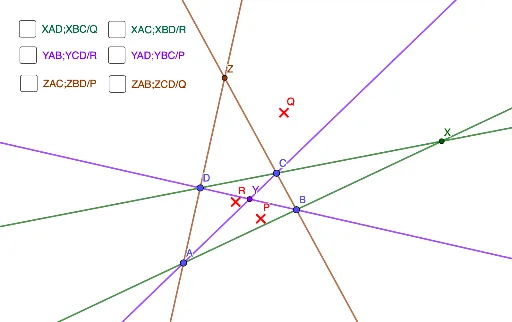
This GeoGebra example demonstrates the rich geometric structures arising from intersections of multiple circleshol. It shows how to construct hyperbolas, kites, and other shapes using circle intersection points, and explores their interconnections. Core mathematical concepts include circle intersection properties, coordinates of intersection points, the definition of a hyperbola (locus of points where the absolute difference of distances to two fixed points is constant), and special quadrilaterals like kites (quadrilaterals with two pairs of adjacent equal sides). Construction highlights: Based on the summary, the example uses GeoGebra commands such as Line, Intersect, and Circle to create multiple circles (e.g., c, d, c_1, d_1) and lines (e.g., f, g, h, i), then finds intersection points (A, B, C, D, X, Y, Z, P, Q, R, etc.) to construct hyperbolas (e.g., a, e, p, b, q, r) and kites (e.g., kite). This example is suitable for high school and above, for teaching analytic geometry, conic sections, and geometric construction, and as a math experiment to help students intuitively understand the relationship between circles and hyperbolas.
GeoGebra Commands & Parameters
Line(A, B) → fLine(D, C) → gIntersect(f, g) → XLine(A, C) → hLine(B, D) → iIntersect(h, i) → YLine(D, A) → jLine(C, B) → kIntersect(j, k) → ZCircle(X, C, B) → cCircle(X, D, A) → dIntersect(c, d, 2) → QCircle(X, C, A) → eCircle(X, D, B) → pIntersect(e, p, 2) → RCircle(Y, A, B) → qCircle(Y, C, D) → rCircle(Y, B, C) → sCircle(Y, A, D) → tIntersect(s, t, 2) → PCircle(Z, C, D) → c_1Circle(Z, A, B) → d_1Circle(Z, D, B) → e_1Circle(Z, C, A) → f_1
AI Drawing Prompt Reference
Draw three circles with centers X, Y, and Z, where circle X passes through points C and B, circle Y through A and B, and circle Z through C and D. Then draw lines f and g intersecting at X, lines h and i at Y, and lines j and k at Z. Next, draw the intersection of circle X and circle D at Q, circle Y and circle A at R, and circle Z and circle C at P. Finally, draw the intersection of circle X and circle A at c, circle X and circle B at d, circle Z and circle D at c_1, and circle Z and circle B at d_1.
The prompt above was compiled from the original drawing commands and is for reference only.