
Christmas Ball
Loading the math board and drawing, please wait…
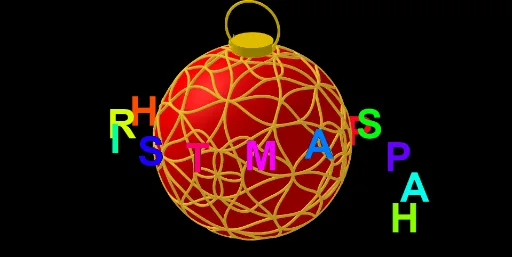
This example demonstrates a Christmas ball using geometric objects such as spheres, lines, circles, and cylinders, along with trigonometric functions and sequence commands. It constructs a beautiful Christmas ball model. The core mathematical concepts involved are trigonometry, sequences, and geometric construction. Suitable for high school mathematics education and learning, particularly in coordinate geometry and solid geometry.
GeoGebra Commands & Parameters
Sequence(CurveCartesian[x(O) + ((R * cos(t)) * cos(i - (π / ((2 * n)) * ff((m * t))))), y(O) + ((R * sin(t)) * cos(i - (π / ((2 * n)) * ff((m * t))))), z(O) + (R * sin(i - (π / ((2 * n)) * ff((m * t))))), t, 0, 6.28319], i, -1.5708, 1.5708, π / n) → liste1Sequence(CurveCartesian[x(O) + ((R * cos(t)) * cos(i + (π / ((2 * n)) * ff((m * t) + (2 * π))))), y(O) + ((R * sin(t)) * cos(i + (π / ((2 * n)) * ff((m * t) + (2 * π))))), z(O) + (R * sin(i + (π / ((2 * n)) * ff((m * t) + (2 * π))))), t, 0, 6.28319], i, -1.5708, 1.5708, π / n) → liste2Sphere(O, R) → cSequence(CurveCartesian[x(O) + (R * sin(i - (π / ((2 * n)) * ff((m * t))))), y(O) + ((R * sin(t)) * cos(i - (π / ((2 * n)) * ff((m * t))))), z(O) + ((R * cos(t)) * cos(i - (π / ((2 * n)) * ff((m * t))))), t, 0, 6.28319], i, -1.5708, 1.5708, π / n) → liste3Sequence(CurveCartesian[x(O) + (R * sin(i + (π / ((2 * n)) * ff((m * t) + (2 * π))))), y(O) + ((R * sin(t)) * cos(i + (π / ((2 * n)) * ff((m * t) + (2 * π))))), z(O) + ((R * cos(t)) * cos(i + (π / ((2 * n)) * ff((m * t) + (2 * π))))), t, 0, 6.28319], i, -1.5708, 1.5708, π / n) → liste4Sequence(CurveCartesian[x(O) + ((R * cos(t)) * cos(i - (π / ((2 * n)) * ff((m * t))))), y(O) + (R * sin(i - (π / ((2 * n)) * ff((m * t))))), z(O) + ((R * sin(t)) * cos(i - (π / ((2 * n)) * ff((m * t))))), t, 0, 6.28319], i, -1.5708, 1.5708, π / n) → liste5Sequence(CurveCartesian[x(O) + ((R * cos(t)) * cos(i + (π / ((2 * n)) * ff((m * t) + (2 * π))))), y(O) + (R * sin(i + (π / ((2 * n)) * ff((m * t) + (2 * π))))), z(O) + ((R * sin(t)) * cos(i + (π / ((2 * n)) * ff((m * t) + (2 * π))))), t, 0, 6.28319], i, -1.5708, 1.5708, π / n) → liste6Line(O, zAxis) → gCircle(C, 1, g) → eCylinder(e, 0.5) → h, k, iCircumcircleArc(E, G + (0, 0, 0.5), F) → qSequence((x(O) + ((1.5 * R) * cos(i + d)), y(O) + ((1.5 * R) * sin(i + d)), z(O) + i - R + 1), i, 0, (2 * π), (2 * π / 15)) → l1Sequence(Text[Element[l2, i], Element[l1, i]], i, 1, Length[l2]) → l3Element(l3, A1) → B1Element(l3, A2) → B2Element(l3, A3) → B3Element(l3, A4) → B4Element(l3, A5) → B5Element(l3, A6) → B6Element(l3, A7) → B7Element(l3, A8) → B8Element(l3, A9) → B9Element(l3, A10) → B10Element(l3, A11) → B11Element(l3, A12) → B12Element(l3, A13) → B13Element(l3, A14) → B14Element(l3, A15) → B15Element(l3, A16) → B16Element(l3, A17) → B17
AI Drawing Prompt Reference
Draw a Christmas ball consisting of a large sphere and multiple small rings around its surface. Use geometric objects like spheres, circles, lines, and cylinders, along with trigonometric functions and sequence commands to construct it. Start by drawing the large sphere, then add multiple small rings around its surface to form the Christmas ball.
The prompt above was compiled from the original drawing commands and is for reference only.