
Chocolate Bar Paradox by Anthony OR 柯志明
Loading the math board and drawing, please wait…
In collections
GeoGebraTube Beta Testing
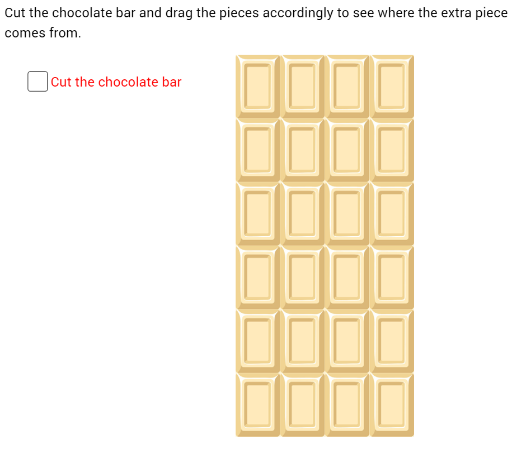
This example demonstrates the chocolate bar paradox, showing that triangles of different shapes can have the same area. It involves key mathematical concepts such as triangles, reflection, and similar triangles. Using commands like Polygon and Reflection, users can explore how triangles of different shapes can have the same area. Suitable for middle and high school students learning geometry and triangle-related concepts.
GeoGebra Commands & Parameters
Polygon(A, A + (4, 0), A + (4, 3), A + (0, 2)) → poly2, a, b, c, dPolygon(B, B + (0, 3), B + (-3, 3), B - (3, 0.75)) → poly3, e, f, g, hPolygon(D, D + (1, 0), D + (1, 1), D + (0, 1)) → poly5, m, n, p, qPolygon(C, C - (1, 0), C - (1, 3), C - (0, 2.75)) → poly4, i, j, k, l
AI Drawing Prompt Reference
Draw a chocolate bar paradox diagram with four triangles. First, draw a right triangle with its base on the x-axis and height of 2. Then, draw another right triangle with its base on the y-axis and width of 3. Next, draw an acute triangle with its vertex at the origin and base on the x-axis with height of 1. Finally, draw an obtuse triangle with its vertex at the origin and base on the y-axis with height of 3.
The prompt above was compiled from the original drawing commands and is for reference only.