
Central Symmetry: A Multi-Concept Geometric Demonstration
Loading the math board and drawing, please wait…
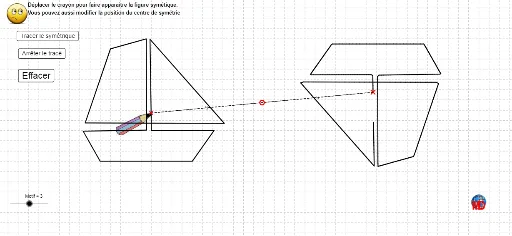
This GeoGebra example dynamically illustrates central symmetry, where a collection of polygons, circles, and line segments are mirrored about a central point O, visually revealing the congruence between original and transformed figures. The core mathematical concepts include central symmetry, reflection transformation, properties of polygons and circles, while also integrating Pythagorean theorem, definite integrals, conic sections, and algebraic means, showcasing the interconnection between geometry and algebra. Construction highlights: basic shapes are built using PolyLine, Polygon, Circle, and Segment; the Mirror command applies central symmetry; Sequence generates series of points; Intersect and Angle tools mark intersections and angles; If conditions control dynamic visibility. Suitable for middle and high school geometry lessons, math lab activities, or teacher-training sessions on geometric transformations, helping learners grasp invariants and structural relationships under symmetry.
GeoGebra Commands & Parameters
PolyLine(O_1, P_1, A_2, O_1, Q_1, R_1, S_1, T_1, U_1, V_1, W_1, Z_1) → q_1Point(q_1) → P_3PolyLine(I, H, N, M, L, K, J, I, G, F, E, D, C, B, A, O) → tPoint(t) → P1Polygon(W, Z, C_1, D_1, E_1, F_1, A_1, B_1, V) → poly2, w, z, c_1, d_1, e_1, f_1, a_1, b_1, vPoint(v) → G_1Point(v) → H_1PolyLine(A_1, F_1, B_1, A_1, E_1, D_1, C_1, Z, W, H_1, G_1, V) → p_1Point(p_1) → P2PolyLine(B_2, C_2, L_2, M_2, B_2, D_2, E_2, F_2, G_2, H_2, I_2, J_2, K_2) → r_1Point(r_1) → P4Polygon(A, B, K, L, M, N, O, C, D, E, F, G, H, I, J) → poly1, a_2, j, k, l, m, n, o, b, c, d, e, f, g, h, iLine(Q, R) → pIf(Motif ≟ 1, P1, If[Motif ≟ 2, P2, If[Motif ≟ 3, P_3, If[Motif ≟ 4, P4, P5]]]) → PMirror(P, R) → SCircle(P, a) → qLine(P, xAxis) → rSequence(Segment[Element[Marque, i], Element[Marque, i + 1]], i, 1, Length[Marque]) → TraitPolygon(H_1, I_1, J_1, G_1) → poly3, h_1, i_1, j_1, g_1Mirror(H_1, p) → K_1Mirror(I_1, p) → L_1Mirror(J_1, p) → M_1Mirror(G_1, p) → N_1Polygon(K_1, L_1, M_1, N_1) → poly3', k_1, l_1, m_1, n_1Segment(P, S) → sIntersect(s, p) → N_2Angle(S, N_2, R) → αCircle(N_2, 1) → s_1Intersect(s_1, p) → O_2, P_2Intersect(s_1, s) → Q_2, R_2Line(R_2, p) → t_1Line(O_2, s) → b_2Intersect(b_2, t_1) → S_2Polygon(N_2, R_2, S_2, O_2) → poly4, n_2, r_2, s_2, o_2Mirror(Trait, R) → Trait'Mirror(H_1, R) → T_2Mirror(I_1, R) → U_2Mirror(J_1, R) → V_2Mirror(G_1, R) → W_2Polygon(T_2, U_2, V_2, W_2) → poly3'_1, t_2, u_2, v_2, w_2Segment(P, R) → c_2Segment(S, R) → c_3