
Celestial Coordinates - Major Stars
Loading the math board and drawing, please wait…
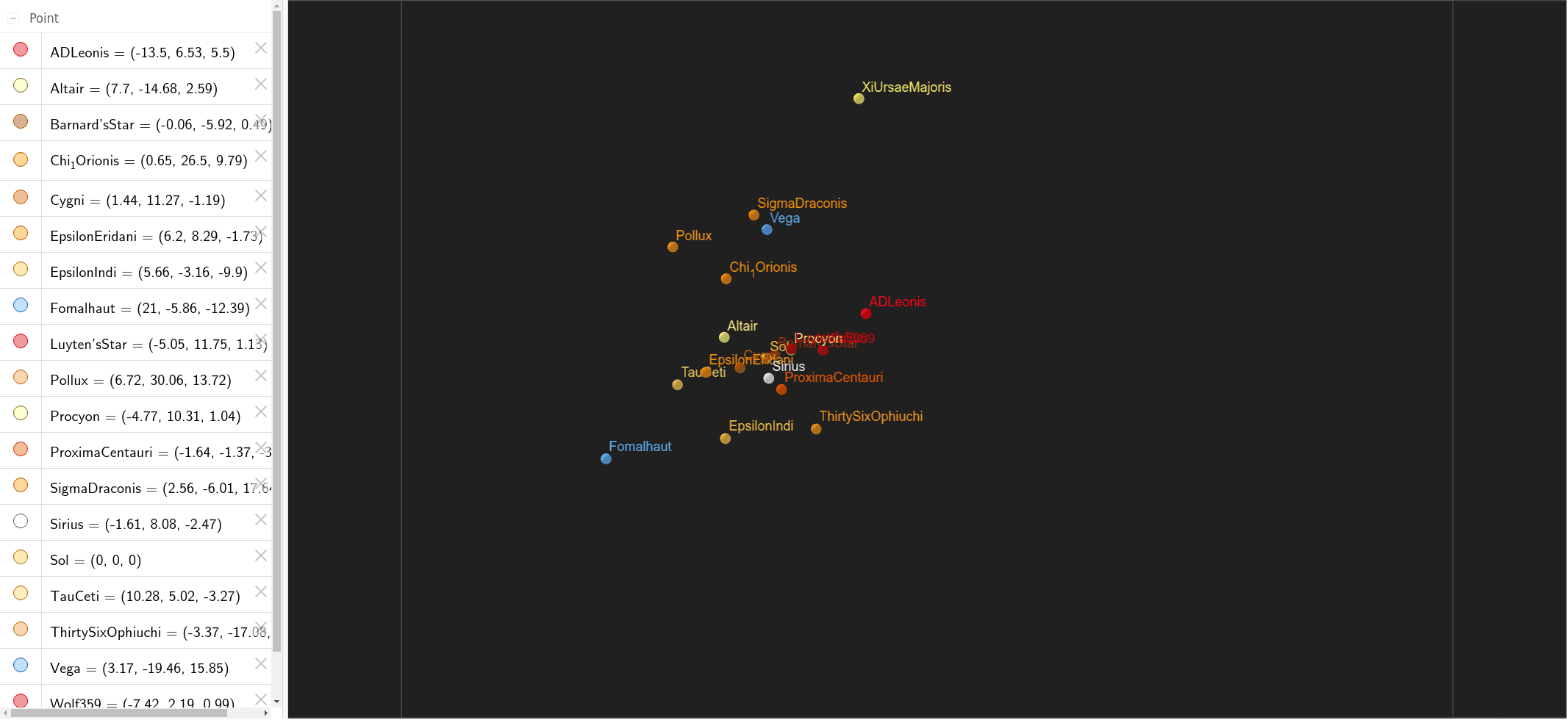
This example demonstrates the positions of major stars in the celestial coordinate system. Key mathematical concepts include trigonometry and coordinate geometry. Using GeoGebra commands such as Pollux, Sol, ProximaCentauri, etc., the positions of these stars in the celestial coordinate system can be constructed. Suitable for astronomy and mathematics enthusiasts.
GeoGebra Commands & Parameters
(6.72, 30.06, 13.72)(0, 0, 0)(-1.643, -1.374, -3.838)(-0.0566, -5.92, 0.486)(-7.416, 2.193, 0.993)(-1.612, 8.078, -2.474)(3.165, -19.46, 15.85)(6.197, 8.294, -1.725)(1.438, 11.27, -1.188)(-4.769, 10.31, 1.039)(10.28, 5.018, -3.267)Point3d Luyten'sStar(-5.045460077043394, 11.745419936688432, 1.127999999999986)(5.658, -3.157, -9.896)(7.703, -14.68, 2.586)(2.564, -6.014, 17.64)(21, -5.857, -12.39)(-11, -3.2, 32)(0.65, 26.5, 9.792)(-3.37, -17.08, -8.716)(-13.5, 6.53, 5.5)
AI Drawing Prompt Reference
Create a 3D scatter plot showing the positions of major stars in celestial coordinates. Place the origin as the observation point, and represent each star as a point in 3D space with coordinates scattered around the axes. The points should form a roughly spherical distribution, with some closer to the origin and others farther out. Include about twenty distinct points, each labeled implicitly by its position, to illustrate the relative spatial arrangement of stars as seen from Earth.
The prompt above was compiled from the original drawing commands and is for reference only.