
Difference of Cubes - Part 2
Loading the math board and drawing, please wait…
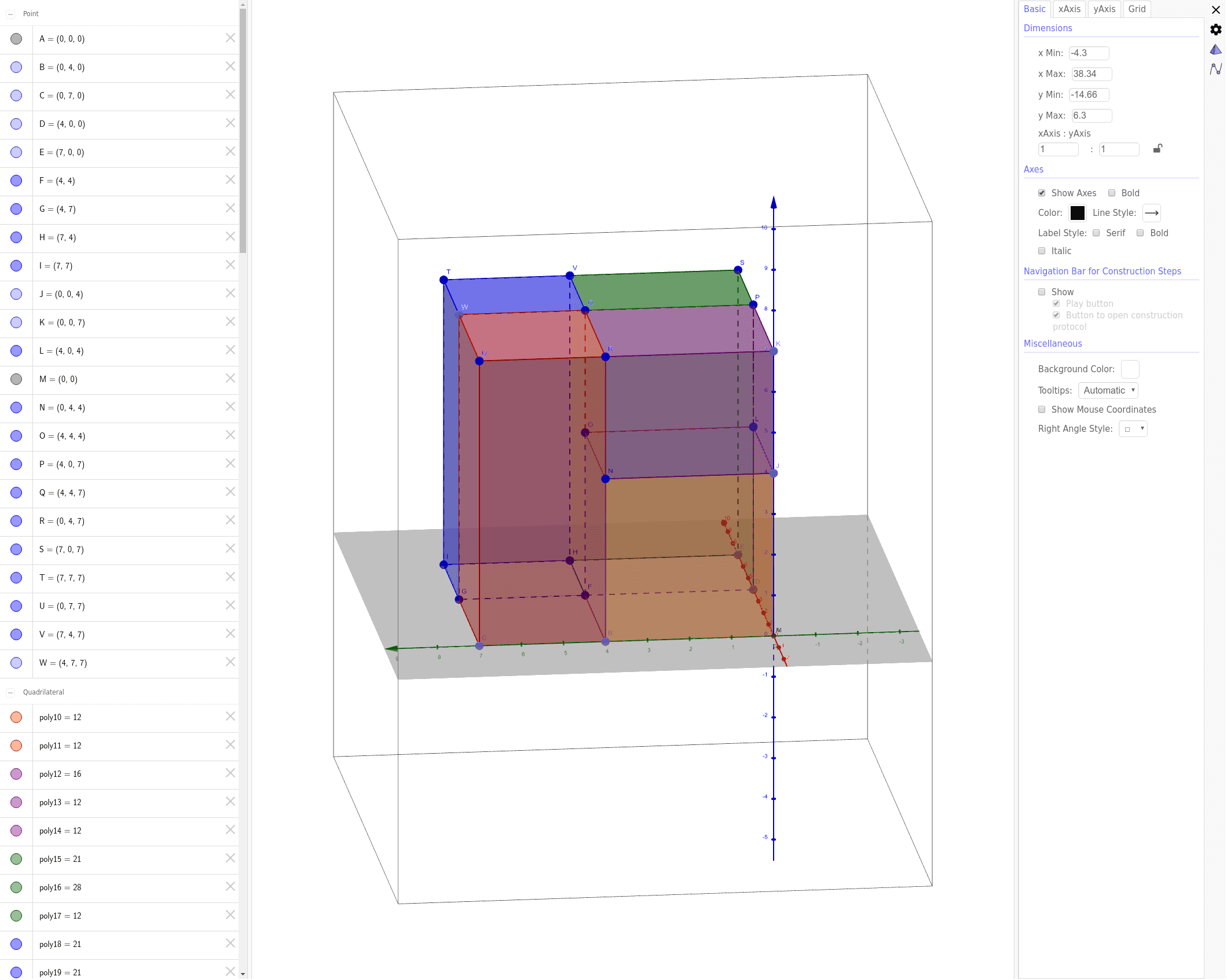
This example demonstrates the geometric meaning of the difference of cubes formula. By constructing the cutting of a cube, it illustrates the difference of cubes formula. Key mathematical concepts include cubes and geometric transformations. GeoGebra commands used include Intersect, Point, Polygon, etc. Suitable for high school mathematics education, helping students understand the geometric background of the difference of cubes formula.
GeoGebra Commands & Parameters
Intersect(yAxis, xAxis) → APoint(yAxis) → BPoint(yAxis) → CPoint(xAxis) → DPoint(xAxis) → EPoint(zAxis) → JPoint(zAxis) → KIntersect(yAxis, zAxis) → MPolygon(F, B, C, G) → poly2, f_1, b_1, c, gPolygon(H, F, G, I) → poly3, h, f_2, g_1, iPolygon(E, D, F, H) → poly4, e, d_1, f_3, h_1Polygon(D, L, J, A) → poly5, d_2, l, j, a_1Polygon(J, N, B, A) → poly6, j_1, n, b_2, a_2Polygon(L, O, F, D) → poly7, l_1, o, f_4, d_3Polygon(O, N, B, F) → poly8, o_1, n_1, b_3, f_5Polygon(L, J, N, O) → poly9, l_2, j_2, n_2, o_2Polygon(Q, P, L, O) → poly10, q, p, l_3, o_3Polygon(O, N, R, Q) → poly11, o_4, n_3, r, q_1Polygon(P, K, R, Q) → poly12, p_1, k, r_1, q_2Polygon(K, J, N, R) → poly13, k_1, j_3, n_4, r_2Polygon(K, J, L, P) → poly14, k_2, j_4, l_4, p_2Polygon(S, E, D, P) → poly15, s, e_1, d_4, p_3Polygon(E, H, V, S) → poly16, e_2, h_2, v, s_1Polygon(V, Q, P, S) → poly17, v_1, q_3, p_4, s_2Polygon(H, V, T, I) → poly18, h_3, v_2, t, i_1Polygon(T, W, G, I) → poly19, t_1, w, g_2, i_2Polygon(Q, W, T, V) → poly20, q_4, w_1, t_2, v_3Polygon(W, U, R, Q) → poly21, w_2, u, r_3, q_5Polygon(U, C, G, W) → poly22, u_1, c_1, g_3, w_3Polygon(U, R, B, C) → poly23, u_2, r_4, b_4, c_2
AI Drawing Prompt Reference
Draw a geometric representation of the difference of cubes formula. Start by drawing the x-axis, y-axis, and z-axis. Then, mark points B and C on the y-axis, D and E on the x-axis, J and K on the z-axis. Next, draw a polygon with points B, C, and G; a polygon with D, F, G, and H; a polygon with E, D, F, and H; a polygon with D, L, J, and A; a polygon with J, N, B, and A; a polygon with L, O, F, and D; a polygon with O, N, B, and F; a polygon with L, J, N, and O; a polygon with Q, P, L, and O; a polygon with O, N, R, and Q; a polygon with P, K, R, and Q; a polygon with K, J, N, and R; a polygon with K, J, L, and P; a polygon with S, E, D, and P; a polygon with E, H, V, and S; a polygon with V, Q, P, and S; a polygon with H, V, T, and I; a polygon with T, W, G, and I; a polygon with Q, W, T, and V; a polygon with W, U, R, and Q; a polygon with U, C, G, and W; a polygon with U, R, B, and C.
The prompt above was compiled from the original drawing commands and is for reference only.