
CCGPS AA 4.1.1 Example 3: Student Loan Compound Interest and Exponential Modelin
Loading the math board and drawing, please wait…
In collections
CCGPS AA Unit 4 Lesson 1
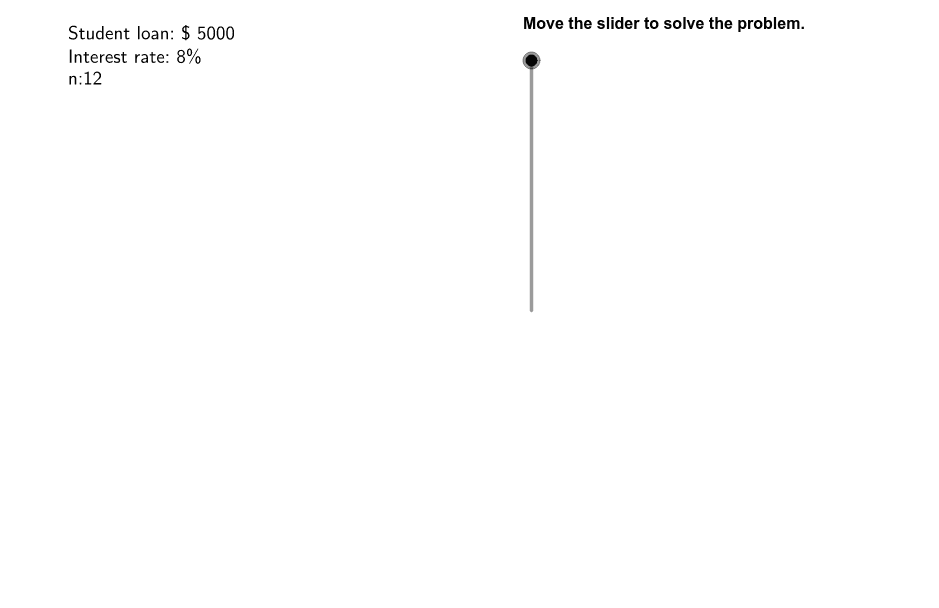
This GeoGebra example demonstrates how to model the accumulation of interest on a $5,000 student loan using exponential functions and compound interest formulas. The core mathematical concepts include compound interest, exponential growth, logarithmic functions, and the interaction between function graphs and the coordinate system. Construction highlights: the example uses GeoGebra commands such as Corner to position coordinate axes, Intersect to find function intersections, and TableText to generate data tables; it also employs sliders (DirectionsSlider, SlideStep) to control parameters and multiple text objects (Formula1a, Reason1a, etc.) to show step-by-step reasoning. This resource is suitable for high school or pre-college students learning exponential functions, compound interest applications, and dynamic mathematical modeling, and is ideal for classroom demonstrations in AP precalculus courses (CCGPS AA).
GeoGebra Commands & Parameters
Corner(3) → C3Corner(2) → C2Intersect(xAxis, yAxis) → OriginTableText({{Formula1a, Reason1a}, {Formula1b, Reason1b}, {Formula1c, Reason1c}}) → Calculation1
AI Drawing Prompt Reference
Create a graph modeling the accumulation of interest on a $5000 student loan using exponential functions and compound interest formulas, with sliders to control parameters, showing the interaction between function graphs and the coordinate system, and text objects for step-by-step reasoning. Start by positioning the coordinate axes, then find function intersections, and finally generate data tables with formulas and explanations.
The prompt above was compiled from the original drawing commands and is for reference only.