
Cavalieri's Principle Demo
Loading the math board and drawing, please wait…
In collections
Area, Surface Area, Volume, Cross Section, 3D
Primary School Mathematics Collection
Volumes and Surface Areas of Pyramids, Cones and Spheres
Mensuration
Volumes and Surface Areas of Pyramids, Cones and Spheres
Volumes in Ancient Chinese Mathematics 中國古算中的體積
More about Volumes and Surface Areas
Volumes of Pyramid and Sphere in Ancient Chinese Mathematics
Connolly Geometry Volume
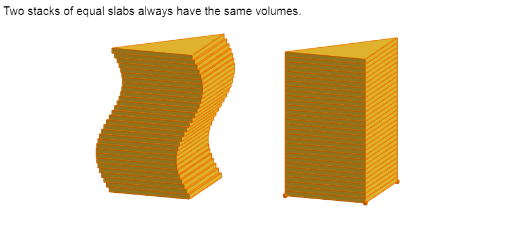
This example dynamically demonstrates Cavalieri's Principle by showing two solids with equal cross-sectional areas. It involves core concepts like volume, cross-sectional area, integral calculus, and solid geometry. GeoGebra commands and objects used include Polygon, Prism, Height, CurveCartesian, Surface, Segment, Point, and Sequence. Suitable for high school students and math enthusiasts learning about solid geometry and integral calculus.
GeoGebra Commands & Parameters
Polygon(A, B, C) → poly1, c, a_1, bPrism(poly1, 3.245704115496874) → d, D, edgeCF, edgeDE, edgeEF, edgeDF, E, F, faceABED, faceBCFE, faceACFD, faceDEF, edgeAD, edgeBEHeight(d) → hIf(t < 0.5, 0, (2 * (t - 0.5))) → t2If(t < 0.5, (2 * t), 1) → t1Polygon(C', A', B') → poly2, b', c', a'CurveCartesian(f(u) + x1, y1, u, u, 0, h) → eCurveCartesian(f(u) + x2, y2, u, u, 0, h) → gCurveCartesian(f(u) + x3, y3, u, u, 0, h) → iSurface((u * (f(v) + x1)) + ((1 - u) * (f(v) + x2)), (u * y1) + ((1 - u) * y2), v, u, 0, 1, v, 0, h) → jSurface((u * (f(v) + x1)) + ((1 - u) * (f(v) + x3)), (u * y1) + ((1 - u) * y3), v, u, 0, 1, v, 0, h) → aSurface((u * (f(v) + x2)) + ((1 - u) * (f(v) + x3)), (u * y2) + ((1 - u) * y3), v, u, 0, 1, v, 0, h) → kSegment(G, G + (0, 0, h)) → lPoint(l) → HPolygon(I, J, K) → poly3, k_1, i_1, j_1Polygon(L, M, N) → poly4, n, l_1, mPolygon(O, P, Q) → poly5, q, o, pPolygon((-7, -7, h'), (7, -7, h'), (7, 7, h'), (-7, 7, h')) → poly6, r, s, b_1, c_1Segment(A, B) → d_1Segment(B, C) → e_1Segment(C, A) → f_1Sequence(Prism[Polygon[(f((i * δ)) + x1, y1, (i * δ)), (f((i * δ)) + x2, y2, (i * δ)), (f((i * δ)) + x3, y3, (i * δ))], δ], i, 0, w - 1) → list2Sequence(Prism[Polygon[(f((i * δ)) + x1, y1, (i * δ)), (f((i * δ)) + x2, y2, (i * δ)), (f((i * δ)) + x3, y3, (i * δ))], δ], i, 0, w - 1) → list2'Sequence(Prism[Polygon[A + (0, 0, (i * δ)), B + (0, 0, (i * δ)), C + (0, 0, (i * δ))], δ], i, 0, w - 1) → list1Sequence(Prism[Polygon[A + (0, 0, (i * δ)), B + (0, 0, (i * δ)), C + (0, 0, (i * δ))], δ], i, 0, w - 1) → list1'