
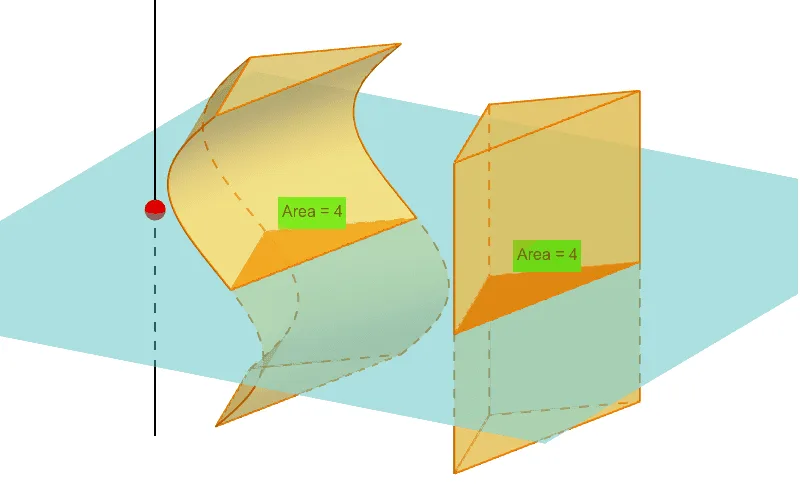
Cavalieri's Principle Demo: Equal Volumes of Prisms
Loading the math board and drawing, please wait…
In collections
Area, Surface Area, Volume, Cross Section, 3D
This example illustrates Cavalieri's principle by constructing two prisms of equal height whose cross‑sectional areas match at every level, thereby showing their volumes are equal. Core concepts include Cavalieri's principle, solid‑geometry volume computation, cross‑sectional area comparison, and properties of prisms and polyhedra. Construction uses Polygon for base faces, Prism to generate the solids, CurveCartesian and Surface for sectional curves and surfaces, and Point, OrthogonalPlane, Intersect, PointIn to create vertices, orthogonal planes, intersection lines, and interior points, yielding a complete 3D model. Suitable for high‑school solid geometry lessons, university calculus introductions to volume integrals, and as a resource for geometric construction and animation demonstrations.
GeoGebra Commands & Parameters
Polygon((1, 0, -2), (2, -3, -2), (3, 2, -2)) → poly1, a, b, cPrism(poly1, 6) → d, A, edge3, edgeAB, edgeBC, edgeAC, B, C, face1, face3, face2, faceABC, edge1, edge2Polygon((-4, 0, -2), (-3, -3, -2), (-2, 2, -2)) → poly2, e, f, gCurveCartesian(sin((π / 3 * (t + 2))) - 4, 0, t, t, -2, 4) → iCurveCartesian(sin((π / 3 * (t + 2))) - 3, -3, t, t, -2, 4) → jPolygon((-4, 0, 4), (-3, -3, 4), (-2, 2, 4)) → poly3, h, l, mCurveCartesian(sin((π / 3 * (t + 2))) - 2, 2, t, t, -2, 4) → kSurface((u * (sin((π / 3 * (t + 2))) - 4)) + ((1 - u) * (sin((π / 3 * (t + 2))) - 3)), (u * 0) + ((1 - u) * (-3)), t, t, -2, 4, u, 0, 1) → nSurface((u * (sin((π / 3 * (t + 2))) - 4)) + ((1 - u) * (sin((π / 3 * (t + 2))) - 2)), (u * 0) + ((1 - u) * 2), t, t, -2, 4, u, 0, 1) → oSurface((u * (sin((π / 3 * (t + 2))) - 2)) + ((1 - u) * (sin((π / 3 * (t + 2))) - 3)), (u * 2) + ((1 - u) * (-3)), t, t, -2, 4, u, 0, 1) → pCurveCartesian(-6, 0, t, t, -10, 10) → qPoint(q) → EOrthogonalPlane(E, zAxis) → rIntersect(edge2, r) → FIntersect(edge3, r) → GIntersect(edge1, r) → HPolygon(H, G, F) → poly4, f_1, h_1, g_1CurveCartesian((u * (sin((π / 3 * (z(E) + 2))) - 4)) + ((1 - u) * (sin((π / 3 * (z(E) + 2))) - 3)), (u * 0) + ((1 - u) * (-3)), z(E), u, 0, 1) → sPolygon(I, J, K) → poly5, k_1, i_1, j_1PointIn(poly4) → Pointpoly4PointIn(poly5) → Pointpoly5