
Casey's Theorem Demonstration
Loading the math board and drawing, please wait…
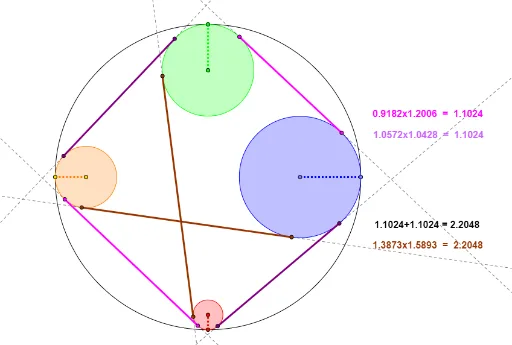
This example demonstrates the geometric construction and application of Casey's theorem, which involves special relationships between circles and triangles. Key math concepts include circles, similarity transformations, triangle similarity, tangent lines, unit circles, etc. GeoGebra commands used in construction are Intersect (intersection), Circle, Point, Segment, Angle, Min, Semicircle, Line, OrthogonalLine, Element. Suitable for high school and above learners to understand geometric constructions and theorem proofs.
GeoGebra Commands & Parameters
Intersect(xAxis, yAxis) → ACircle(A, 1) → cPoint(c) → BSegment(A, B) → aPoint(a) → CCircle(C, B) → dPoint(c) → DAngle(B, A, D) → αSegment(C, B) → r_1Segment(D, A) → bCircle(D, s) → eIntersect(e, b, 1) → ECircle(E, D) → fSegment(D, E) → gPoint(g) → FCircle(F, D) → hPoint(c) → GAngle(B, A, G) → β_1Angle(D, A, G) → β_2Segment(D, F) → r_2Segment(G, A) → iMin(t_1, t_2) → tCircle(G, t) → pIntersect(p, i, 1) → HSegment(G, H) → jPoint(j) → ICircle(I, G) → qPoint(c) → JAngle(B, A, J) → γ_1Angle(D, A, J) → γ_2Angle(G, A, J) → γ_3Segment(G, I) → r_3Min(u_1, Min[u_2, u_3]) → uSegment(A, J) → lCircle(J, u) → rIntersect(r, l) → K,Circle(K, J) → c_1Segment(J, K) → mPoint(m) → LCircle(L, J) → d_1Segment(J, L) → r_4Semicircle(F, C) → e_1Semicircle(I, F) → f_1Semicircle(L, I) → g_1Semicircle(C, L) → h_1Circle(C, r_5) → k_1Circle(F, r_6) → p_1Circle(I, r_7) → q_1Intersect(e_1, k_1, 1) → MIntersect(f_1, p_1, 1) → NIntersect(g_1, q_1, 1) → OLine(F, M) → nOrthogonalLine(F, n) → a_1OrthogonalLine(C, n) → b_1Intersect(h, a_1, 2) → PIntersect(d, b_1, 2) → QLine(I, N) → i_1OrthogonalLine(I, i_1) → j_1OrthogonalLine(F, i_1) → n_1Intersect(q, j_1, 2) → RIntersect(h, n_1, 2) → SLine(O, L) → s_1OrthogonalLine(L, s_1) → a_6OrthogonalLine(I, s_1) → b_2Intersect(q, b_2, 1) → TIntersect(d_1, a_6, 1) → USegment(P, Q) → c_2Segment(R, S) → d_2Segment(T, U) → e_2Circle(C, r_8) → f_2Intersect(h_1, f_2, 1) → VLine(V, L) → g_5OrthogonalLine(C, g_5) → h_2OrthogonalLine(L, g_5) → i_2Intersect(d, h_2, 2) → WIntersect(d_1, i_2, 2) → ZSegment(W, Z) → j_2Circle(C, r_9) → k_2Circle(F, r_{10}) → p_2Semicircle(C, I) → q_2Semicircle(L, F) → s_2Intersect(k_2, q_2, 1) → A_1Intersect(p_2, s_2, 1) → B_1Line(I, A_1) → n_2OrthogonalLine(I, n_2) → a_3OrthogonalLine(C, n_2) → b_3Intersect(q, a_3, 1) → C_1Intersect(d, b_3, 1) → D_1Segment(C_1, D_1) → a_2Line(B_1, L) → d_3OrthogonalLine(F, d_3) → e_3OrthogonalLine(L, d_3) → f_3Intersect(h, e_3, 1) → E_1Intersect(d_1, f_3, 1) → F_1Segment(E_1, F_1) → g_3Circle(F, (-r_5)) → h_3Circle(I, (-r_6)) → k_3Circle(L, (-r_7)) → p_3Intersect(e_1, h_3, 1) → G_1Line(G_1, C) → i_3OrthogonalLine(F, i_3) → j_3OrthogonalLine(C, i_3) → l_3Intersect(h, j_3, 2) → H_1Intersect(d, l_3, 2) → I_1Intersect(f_1, k_3, 1) → J_1Line(J_1, F) → n_3OrthogonalLine(F, n_3) → q_3OrthogonalLine(I, n_3) → s_3Intersect(q, s_3, 2) → K_1Intersect(h, q_3, 2) → L_1Intersect(g_1, p_3, 1) → M_1Line(I, M_1) → t_3OrthogonalLine(I, t_3) → a_4OrthogonalLine(L, t_3) → b_4Intersect(q, a_4, 1) → N_1Intersect(d_1, b_4, 1) → O_1Segment(I_1, H_1) → c_4Segment(L_1, K_1) → d_4Segment(N_1, O_1) → e_4Circle(L, (-r_8)) → f_4Intersect(h_1, f_4, 1) → P_1Line(C, P_1) → g_4OrthogonalLine(C, g_4) → h_4OrthogonalLine(L, g_4) → i_4Intersect(d, h_4, 2) → Q_1Intersect(d_1, i_4, 2) → R_1Segment(R_1, Q_1) → j_4Circle(I, (-r_9)) → k_4Circle(L, (-r_{10})) → p_4Intersect(q_2, k_4, 1) → S_1Line(S_1, C) → l_4OrthogonalLine(I, l_4) → m_4OrthogonalLine(C, l_4) → n_4Intersect(q, m_4, 1) → T_1Intersect(d, n_4, 1) → U_1Intersect(s_2, p_4, 1) → V_1Line(F, V_1) → q_4OrthogonalLine(F, q_4) → s_4OrthogonalLine(L, q_4) → t_4Intersect(h, s_4, 1) → W_1Intersect(d_1, t_4, 1) → Z_1Segment(T_1, U_1) → a_5Segment(W_1, Z_1) → g_2Element(RemoveUndefined[{a_2, a_5}], 1) → a_7Element(RemoveUndefined[{c_2, c_4}], 1) → c_7Element(RemoveUndefined[{e_2, e_4}], 1) → e_7Element(RemoveUndefined[{d_2, d_4}], 1) → d_7Element(RemoveUndefined[{g_2, g_3}], 1) → g_7Element(RemoveUndefined[{j_2, j_4}], 1) → j_7Line(P, Q) → c_3Line(T, U) → b_5Line(Z, W) → c_5Line(D_1, C_1) → d_5Line(E_1, F_1) → e_5Line(R, S) → f_5Line(H_1, I_1) → h_5Line(K_1, L_1) → i_5Line(T_1, U_1) → j_5Line(W_1, Z_1) → k_5Line(N_1, O_1) → l_5Line(R_1, Q_1) → m_5