
Cartesian Representation of Complex Numbers: Vector Visualization
Loading the math board and drawing, please wait…
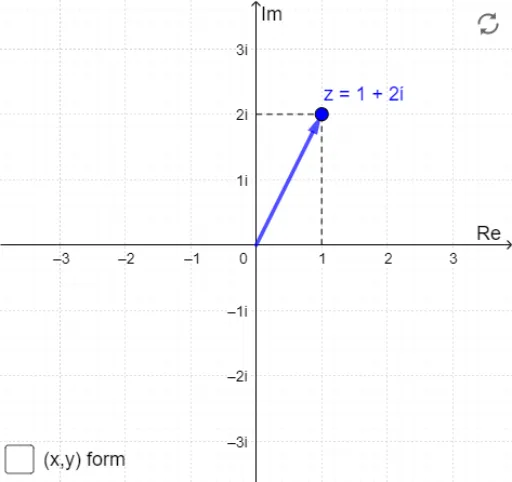
① This GeoGebra example dynamically illustrates the Cartesian (rectangular) representation of complex numbers on the complex plane, showing a complex number a+bi as a vector from the origin with projections on the real and imaginary axes. ② The core mathematical concepts include the algebraic form of complex numbers, the complex plane, real and imaginary axes, and the correspondence between complex numbers and 2D vectors, aiding comprehension of the geometric meaning of complex arithmetic. ③ Construction highlights: using GeoGebra's Vector command to draw the complex vector, Segment command to construct the projection segments for real and imaginary parts; involved objects include complex point Z, vector u, auxiliary functions f and g, parameter a, and point A—dragging parameter a dynamically changes the real and imaginary parts, updating the vector. ④ Suitable for high school and early college students learning complex numbers, for classroom demonstration or self-study, and as a reference for teachers creating interactive complex-number teaching materials.
GeoGebra Commands & Parameters
Vector((0, 0), Z) → uSegment((x(Z), 0), Z) → fSegment((0, y(Z)), Z) → g
AI Drawing Prompt Reference
Draw a complex plane with horizontal real axis and vertical imaginary axis. Place a point Z representing the complex number a+bi, and draw a vector from the origin to Z. From Z, draw two perpendicular segments: one to the real axis and one to the imaginary axis, showing the projections. Include a slider to adjust the values of a and b, which dynamically change the position of Z and the vector. The graphic should clearly illustrate the Cartesian representation of a complex number as a vector with its real and imaginary components, suitable for educational purposes.
The prompt above was compiled from the original drawing commands and is for reference only.