
Calculating the Cross Product of Two Vectors
Loading the math board and drawing, please wait…
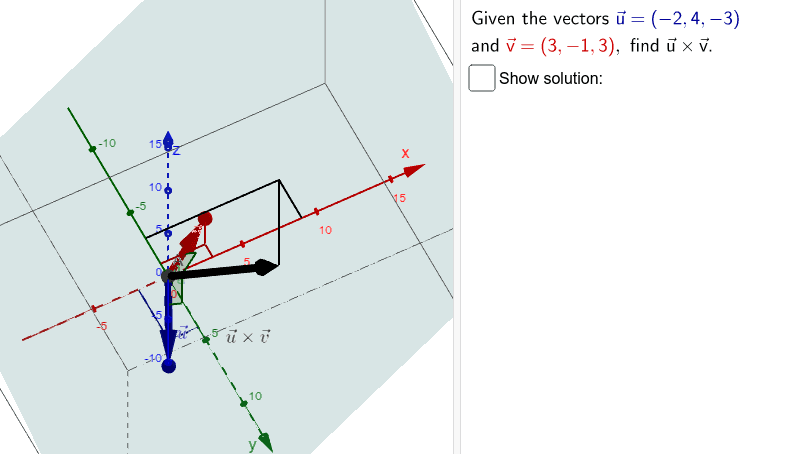
This example demonstrates the calculation and geometric interpretation of the cross product of two vectors in three-dimensional space. Key math concepts include vectors, 3D space, cross product, vector magnitude and direction. It utilizes GeoGebra commands and objects such as Intersect, Vector, TableText, Plane, Angle, Segment, and LaTeX. Suitable for high school and above students learning vector operations and solid geometry.
GeoGebra Commands & Parameters
Intersect(xAxis, zAxis) → AVector(A, B) → uVector(A, C) → vTableText({{LaTeX["\hat{i}"], LaTeX["\hat{j}"], LaTeX["\hat{k}"]}, {LaTeX[(("\textcolor{#000099}{" * x(B)) * "}")], LaTeX[(("\textcolor{#000099}{" * y(B)) * "}")], LaTeX[(("\textcolor{#000099}{" * z(B)) * "}")]}, {LaTeX[(("\textcolor{#CC0000}{" * x(C)) * "}")], LaTeX[(("\textcolor{#CC0000}{" * y(C)) * "}")], LaTeX[(("\textcolor{#CC0000}{" * z(C)) * "}")]}}, "||c") → text2Plane(A, B, C) → aAngle(u, crossProduct) → αAngle(v, crossProduct) → βSegment((x(crossProduct), y(crossProduct), z(crossProduct)), D) → bSegment(D, F) → cSegment(D, E) → dSegment(B, G) → eSegment(H, G) → fSegment(I, G) → gSegment(C, J) → hSegment(K, J) → iSegment(L, J) → jLaTeX((((((((((((((((((((((((((((((((("\textcolor{#000099}{\vec{u}}\times\textcolor{#CC0000}{\vec{v}}\cr=\text{ }" * text2) * " \cr=\hat{i}[(\textcolor{#000099}{") * y(B)) * "})(\textcolor{#CC0000}{") * z(C)) * "})-(\textcolor{#000099}{") * z(B)) * "})(\textcolor{#CC0000}{") * y(C)) * "})] \cr\text{ }-\hat{j}[(\textcolor{#000099}{") * x(B)) * "})(\textcolor{#CC0000}{") * z(C)) * "})-(\textcolor{#000099}{") * z(B)) * "})(\textcolor{#CC0000}{") * x(C)) * "})] \cr\text{ }+\hat{k}[(\textcolor{#000099}{") * y(B)) * "})(\textcolor{#CC0000}{") * z(C)) * "})-(\textcolor{#000099}{") * z(B)) * "})(\textcolor{#CC0000}{") * y(C)) * "})] \cr=(") * x(crossProduct)) * ",") * y(crossProduct)) * ",") * z(crossProduct)) * ")")) → text3