
Building Similar Triangles V2
Loading the math board and drawing, please wait…
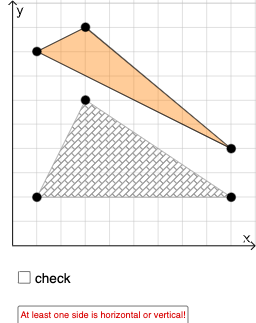
① This example demonstrates how to construct two similar triangles dynamically, showing that corresponding angles are equal and corresponding sides are proportional. ② The core mathematical concepts are similarity of triangles, angle measurement, side ratios, and the criteria for similarity (AA, SAS, SSS). ③ Construction details: using GeoGebra commands such as PointIn to place points inside triangles, Polygon to create polygons, Segment for sides, InteriorAngles to compute internal angles, Sort to order angles or side lengths, and If for conditional checks; objects include triangles ABC and DEF, incircle c_1, tangent lines, auxiliary segments, angles α-ζ, lists l1-l4, and text labels. ④ Suitable for middle school or high school geometry classes, useful for exploring similarity criteria and as a dynamic geometry investigation tool.
GeoGebra Commands & Parameters
PointIn(e) → APointIn(e) → BPointIn(e) → CPolygon(A, B, C) → t1, c_1, a_1, b_1Segment(B, C) → fSegment(C, A) → gSegment(A, B) → hPolygon(F, D, E) → t2, e_1, f_1, d_1InteriorAngles(t2) → α, β, γInteriorAngles(t1) → δ, ε, ζSort({α, β, γ}) → l1Sort({ε, δ, ζ}) → l2Segment(E, D) → jSegment(D, F) → kSegment(F, E) → lSort({j, k, l}) → l3Sort({f, g, h}) → l4If(l1 ≟ l2 ∧ l3 ≠ l4, "✓", "X") → text1If(l3 ≟ l4 ∧ l1 ≟ l2, "Triangles are similar. Yet they're also congruent.") → text2If((¬nr1) ∨ (¬nr2), "At least one side is horizontal or vertical!") → text3
AI Drawing Prompt Reference
Dynamically construct two triangles in the plane from three adjustable points each, and draw their three corresponding sides. Display the interior angles of the second triangle and the interior angles of the first triangle, then organize the three angles from each triangle for comparison. Also take the three side lengths from each triangle, organize them in the same way, and compare the resulting length groups. Based on whether the grouped angles match and whether the grouped side lengths match or not, show a small status mark and a short text message on the diagram, allowing you to visually verify that corresponding angles are equal and corresponding sides are proportional, and to observe whether a stronger relation may also occur.
The prompt above was compiled from the original drawing commands and is for reference only.