
Bisection Method to Find Real Roots of an Equation
Loading the math board and drawing, please wait…
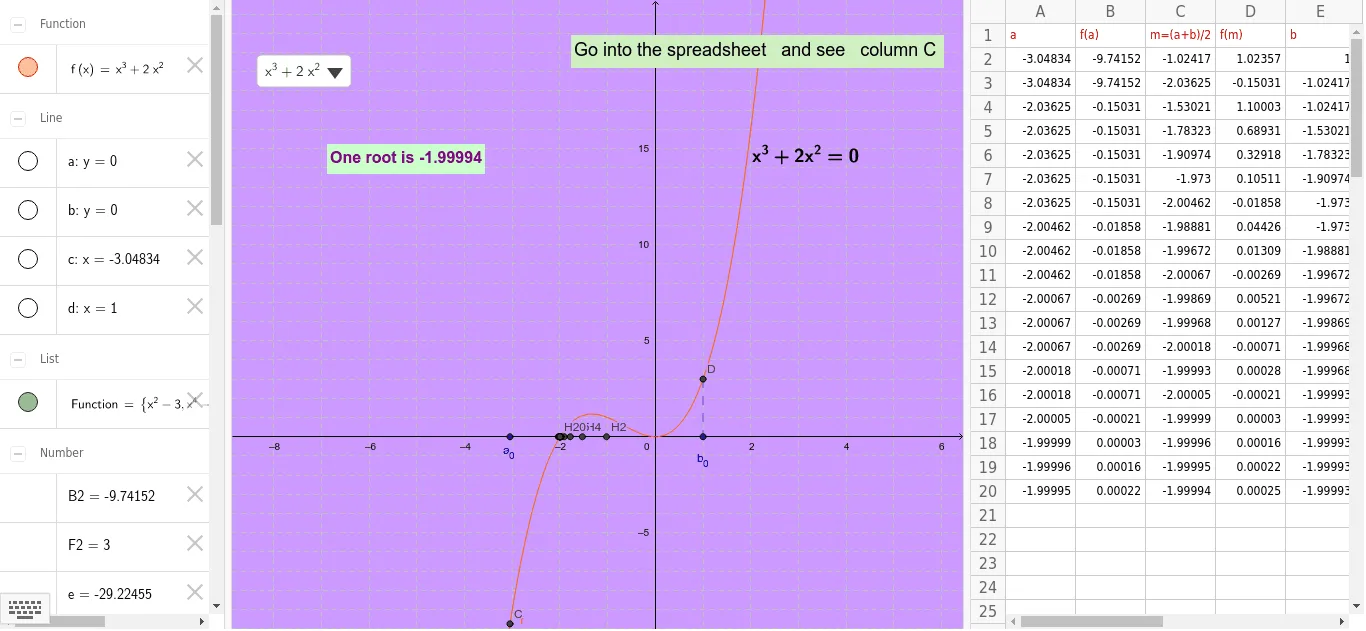
This example demonstrates the bisection method for finding real roots of an equation. Key mathematical concepts include functions, intervals, midpoints, and convergence. The construction involves commands like Point, Line, Intersect, etc., to build the solution process. Suitable for high school mathematics education and learning.
GeoGebra Commands & Parameters
Point(xAxis) → APoint(xAxis) → BSelectedElement(Function) → fIf((B2 * D2) < 0, true, false) → G2If(G2, A2, C2) → A3If(G2, C2, E2) → E3If((B3 * D3) < 0, true, false) → G3If(G3, A3, C3) → A4If(G3, C3, E3) → E4If((B4 * D4) < 0, true, false) → G4If(G4, A4, C4) → A5If(G4, C4, E4) → E5If((B5 * D5) < 0, true, false) → G5If(G5, A5, C5) → A6If(G5, C5, E5) → E6If((B6 * D6) < 0, true, false) → G6If(G6, A6, C6) → A7If(G6, C6, E6) → E7If((B7 * D7) < 0, true, false) → G7If(G7, A7, C7) → A8If(G7, C7, E7) → E8If((B8 * D8) < 0, true, false) → G8If(G8, A8, C8) → A9If(G8, C8, E8) → E9If((B9 * D9) < 0, true, false) → G9If(G9, A9, C9) → A10If(G9, C9, E9) → E10If((B10 * D10) < 0, true, false) → G10If(G10, A10, C10) → A11If(G10, C10, E10) → E11If((B11 * D11) < 0, true, false) → G11If(G11, A11, C11) → A12If(G11, C11, E11) → E12If((B12 * D12) < 0, true, false) → G12If(G12, A12, C12) → A13If(G12, C12, E12) → E13If((B13 * D13) < 0, true, false) → G13If(G13, A13, C13) → A14If(G13, C13, E13) → E14If((B14 * D14) < 0, true, false) → G14If(G14, A14, C14) → A15If(G14, C14, E14) → E15If((B15 * D15) < 0, true, false) → G15If(G15, A15, C15) → A16If(G15, C15, E15) → E16If((B16 * D16) < 0, true, false) → G16If(G16, A16, C16) → A17If(G16, C16, E16) → E17If((B17 * D17) < 0, true, false) → G17If(G17, A17, C17) → A18If(G17, C17, E17) → E18If((B18 * D18) < 0, true, false) → G18If(G18, A18, C18) → A19If(G18, C18, E18) → E19If((B19 * D19) < 0, true, false) → G19If(G19, A19, C19) → A20If(G19, C19, E19) → E20If((B20 * D20) < 0, true, false) → G20Line(A, xAxis) → aLine(A, a) → bOrthogonalLine(A, b) → cOrthogonalLine(B, b) → dIntersect(f, c) → CIntersect(f, d) → DSegment(D, B) → gText(f) → text2If(e > 0, text4, text1) → text5