
Birthday Paradox Simulation
Loading the math board and drawing, please wait…
In collections
Statistics Simulations
Statistics Simulations
Statistics Demonstrations
Statistics Demonstrations
Statistics Demonstrations
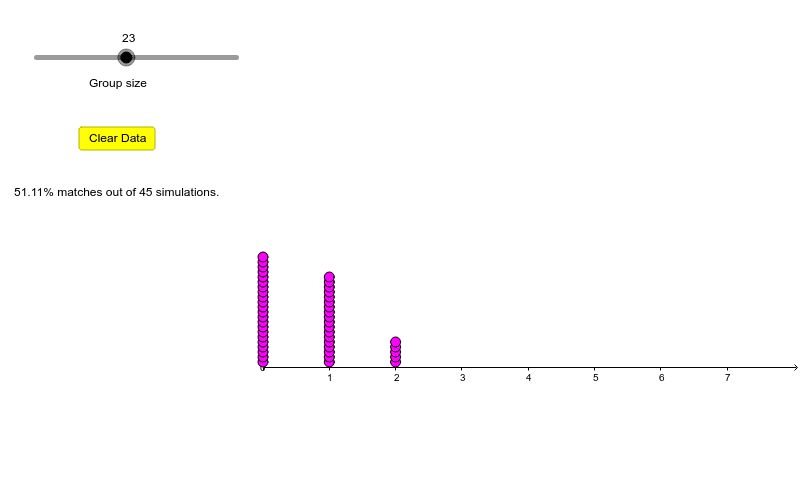
This example demonstrates the probability that in a group of N people, there is at least one pair with the same birthday. It illustrates how the probability of a shared birthday rises rapidly with increasing group size. The core math concepts involve combinatorics and probability theory. It is constructed using GeoGebra commands/objects like Sequence, Sort, Sum, DotPlot, and CountIf. Suitable for high school students and above to understand counterintuitive phenomena in probability.
GeoGebra Commands & Parameters
Sequence(Random[1, 365], a, 1, n) → list4Sort(list4) → list2Sequence(If[Element[list2, a] ≟ Element[list2, a + 1], 1, 0], a, 1, 22) → list3Sum(list3) → aDotPlot(data, true, 0.5) → list1CountIf(x ≥ 0, data) → cCountIf(x > 0, data) → d