
Basic Trigonometric Ratio Problem Exercises Generator
Loading the math board and drawing, please wait…
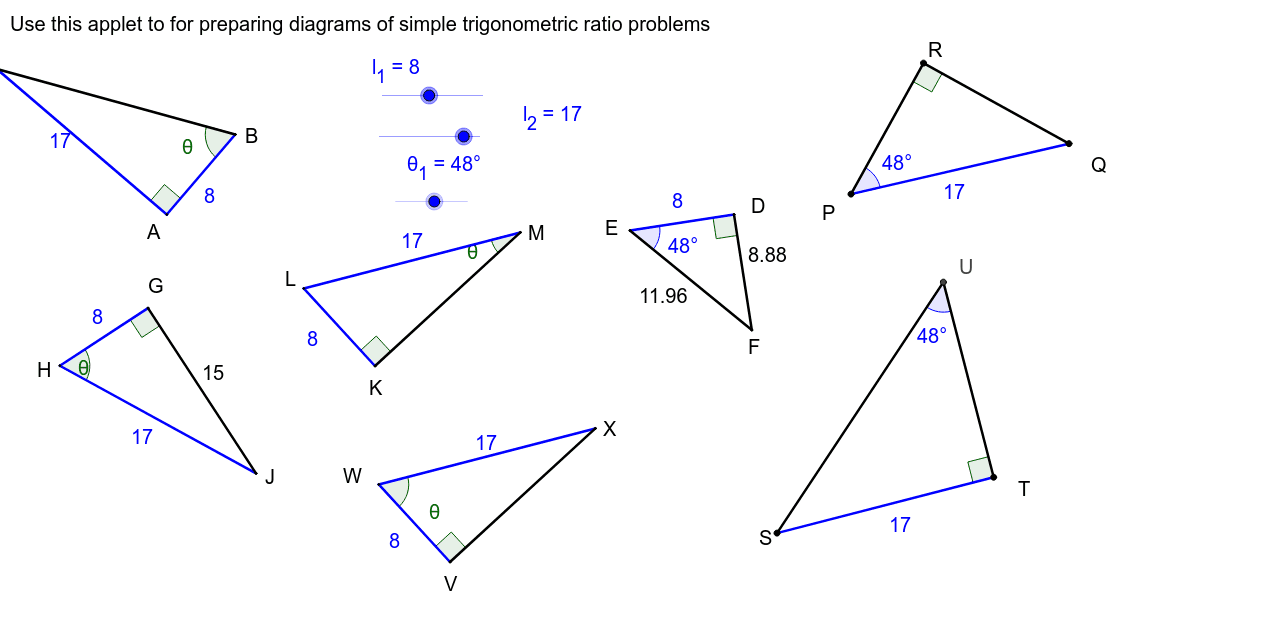
This applet generates diagrams for basic trigonometric ratio problem exercises. It involves concepts of sine, cosine, and ratios. Using GeoGebra commands such as Intersect, Point, Segment, OrthogonalLine, Circle, Angle, Rotate, etc., various geometric shapes can be constructed. Suitable for middle and high school students to learn and practice trigonometry.
GeoGebra Commands & Parameters
Intersect(xAxis, yAxis) → APoint(Circle[A, l_1]) → BSegment(A, B) → aOrthogonalLine(A, a) → bCircle(A, l_2) → cIntersect(c, b) → C_1, CSegment(A, C) → dSegment(B, C) → eAngle(B, A, C) → αPoint(xAxis) → DPoint(Circle[D, l_1]) → ESegment(D, E) → fOrthogonalLine(D, f) → gRotate(D, -θ_1, E) → D'Angle(D', E, D) → θLine(E, D') → hIntersect(h, g) → FSegment(E, F) → iSegment(D, F) → jAngle(E, D, F) → βDistance(f, j) → kDistance(e, a) → lAngle(C, B, A) → γPoint(Circle[G, l_1]) → HSegment(G, H) → mOrthogonalLine(G, m) → nCircle(H, l_2) → pIntersect(p, n) → I, JSegment(H, J) → qSegment(G, J) → rAngle(H, G, J) → δAngle(J, H, G) → εPoint(Circle[K, l_1]) → LSegment(K, L) → sCircle(L, l_2) → tOrthogonalLine(K, s) → a_1Intersect(t, a_1) → M, NSegment(L, M) → b_1Segment(K, M) → c_1Angle(M, K, L) → ζAngle(L, M, K) → ηPoint(Circle[P, l_2]) → QSegment(P, Q) → d_1Rotate(Q, θ_1, P) → Q'Angle(Q, P, Q') → ιRotate(P, -(90° - θ_1), Q) → P'Angle(P', Q, P) → κLine(P, Q') → e_1Line(Q, P') → f_1Intersect(e_1, f_1) → RSegment(Q, R) → g_1Segment(P, R) → h_1Angle(P, R, Q) → λPoint(Circle[S, l_2]) → TSegment(S, T) → i_1OrthogonalLine(T, i_1) → j_1Rotate(T, 90° - θ_1, S) → T'Angle(T, S, T') → μLine(S, T') → k_1Intersect(j_1, k_1) → USegment(T, U) → m_1Segment(S, U) → n_1Angle(U, T, S) → νAngle(S, U, T) → ξPoint(Circle[V, l_1]) → WSegment(V, W) → s_1Circle(W, l_2) → t_1OrthogonalLine(V, s_1) → a_2Intersect(t_1, a_2) → X, N_1Segment(W, X) → b_2Segment(V, X) → c_2Angle(X, V, W) → ζ_1Angle(X, W, V) → η_1
AI Drawing Prompt Reference
Draw a right triangle ABC with AB as the base, AC as the hypotenuse, and ∠BAC as the right angle. Then take a point D on AB and draw a circle with D as the center, intersecting AC at point E, with DE as the chord. Construct the perpendicular line to DE intersecting AC at point F, and connect DF. Next, rotate DE counterclockwise by θ1 degrees around D to get DE', and construct ∠ED'E. Then draw a circle with E as the center, intersecting DE' at point F', and connect EF'. Construct the perpendicular line to EF' intersecting DE at point G, and connect EG. Finally, rotate EF' counterclockwise by (90°-θ1) degrees around E to get EF'', and construct ∠FE'F''.
The prompt above was compiled from the original drawing commands and is for reference only.