
Basic Parallelogram Properties
Loading the math board and drawing, please wait…
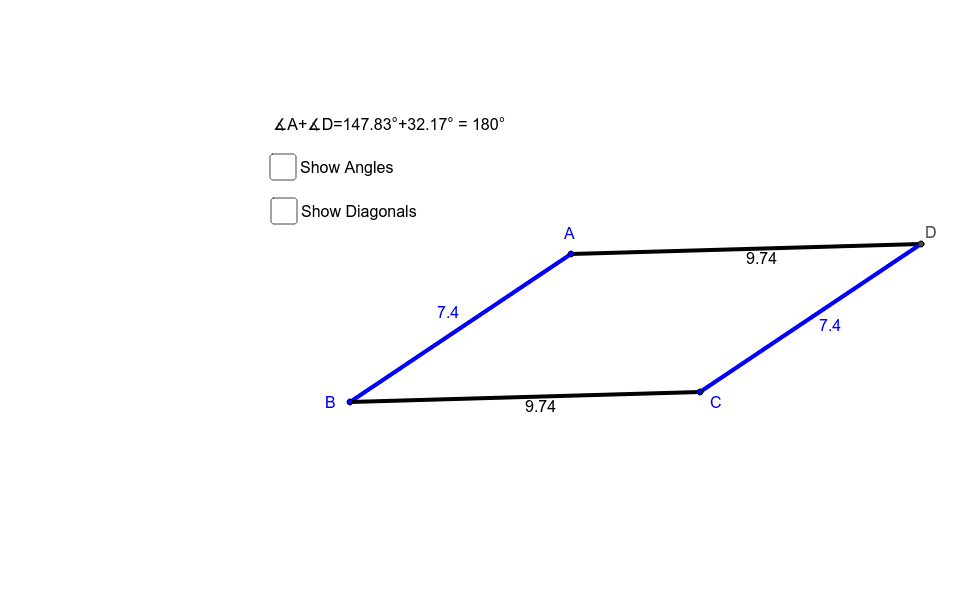
This example demonstrates the geometric properties and vector relationships of a parallelogram. Core math concepts include the definition of a parallelogram, vector addition, angle measurement, and similarity transformations. Construction highlights the use of GeoGebra commands like Segment, Line, Intersect, and Angle. Suitable for middle school students and above learning parallelogram properties and vector applications.
GeoGebra Commands & Parameters
Segment(A, B) → aLine(C, a) → bSegment(B, C) → cLine(A, c) → dIntersect(b, d) → DSegment(A, D) → eSegment(C, D) → fAngle(B, A, D) → αAngle(C, B, A) → βAngle(D, C, B) → γAngle(A, D, C) → δSegment(A, C) → hSegment(B, D) → iIntersect(h, i) → ESegment(E, C) → jSegment(E, B) → kSegment(E, A) → lSegment(E, D) → m
AI Drawing Prompt Reference
Draw a parallelogram, showing its opposite sides are parallel and equal in length, and the diagonals bisect each other. Represent the two diagonals as vectors, and measure the key angles, including adjacent and diagonal angles. Connect the intersection point of the diagonals to each vertex, forming four smaller triangles and label their similarity relationships.
The prompt above was compiled from the original drawing commands and is for reference only.