
Basic Operations with Complex Numbers
Loading the math board and drawing, please wait…
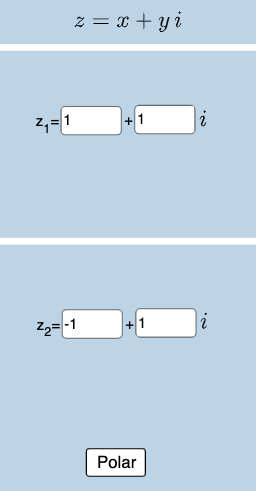
This example demonstrates basic operations with complex numbers, including addition, subtraction, multiplication, and division. By inputting the real and imaginary parts of complex numbers, you can see the results visually. It uses commands like If, Textfield, Segment, Vector, etc., suitable for students at the junior high school level and above.
GeoGebra Commands & Parameters
If(form ≟ true, ((const1 * x(Apolar)) + (const2 * x(Bpolar)), (const1 * y(Apolar)) + (const2 * y(Bpolar))), ((const1 * a) + (const2 * c), (const1 * b) + (const2 * d))) → Z5If(form ≟ true, (((x(Apolar) * x(Bpolar)) + (y(Apolar) * y(Bpolar))) / (x(Bpolar)^(2) + y(Bpolar)^(2)), ((y(Apolar) * x(Bpolar)) - (x(Apolar) * y(Bpolar))) / (x(Bpolar)^(2) + y(Bpolar)^(2))), (((a * c) + (b * d)) / (c^(2) + d^(2)), ((b * c) - (a * d)) / (c^(2) + d^(2)))) → Z4If(form ≟ true, ((x(Apolar) * x(Bpolar)) - (y(Apolar) * y(Bpolar)), (y(Apolar) * x(Bpolar)) + (x(Apolar) * y(Bpolar))), ((a * c) - (b * d), (b * c) + (a * d))) → Z3If(form ≟ true, (x(Apolar) - x(Bpolar), y(Apolar) - y(Bpolar)), (a - c, b - d)) → Z2Textfield(xA) → InputBox1Textfield(yA) → InputBox2Textfield(xB) → InputBox3Textfield(yB) → InputBox4Segment((0, 0), A) → rASegment((0, 0), B) → rBIf(form ≟ true, (x(Apolar) + x(Bpolar), y(Apolar) + y(Bpolar)), (a + c, b + d)) → Z1Segment((0, 0), Z1) → rZ1Segment((0, 0), Z2) → rZ2Segment((0, 0), Z3) → rZ3Segment((0, 0), Z4) → rZ4Vector((0, 0), A) → uAVector((0, 0), B) → uBVector((0, 0), Z1) → uZ1Vector((0, 0), Z2) → uZ2Vector((0, 0), Z3) → uZ3Vector((0, 0), Z4) → uZ4SelectedIndex(operation) → indexopAngle((1000, 0), (0, 0), Element[points, indexop]) → εAngle(Element[points, indexop], (0, 0), (1000, 0)) → ζSegment(B', Z1) → fSegment(A', Z1) → gVector((0, 0), A') → uA'Vector((0, 0), B') → uB'Mirror(uB', (0, 0)) → uB''Segment(A', Z2) → hSegment(Z2, Bminus) → iTextfield(guessx) → InputBox5Textfield(guessy) → InputBox6Ray((0, 0), Element[points, indexop]) → RayzVector((0, 0), Z5) → uZ5Vector((0, 0), A'') → uA''Vector((0, 0), B'') → uB3Vector((0, 0), A) → uVector((0, 0), B) → vTextfield(const1) → InputBox7Textfield(const2) → InputBox8Segment(Z5, A'') → jSegment(Z5, B'') → kAngle((1000, 0), (0, 0), Apolar) → αAngle(Apolar, (0, 0), (1000, 0)) → βAngle((1000, 0), (0, 0), Bpolar) → γAngle(Bpolar, (0, 0), (1000, 0)) → δIf(form ≟ true, (x(Apolar) + x(Bpolar), y(Apolar) + y(Bpolar)), (a + c, b + d)) → ZZVector((0, 0), Apolar) → upolarVector((0, 0), Bpolar) → vpolarVector((0, 0), Apolar') → wVector((0, 0), Bpolar') → eVector((0, 0), Apolar) → lVector((0, 0), Bpolar) → mVector((0, 0), Bpolarminus) → nTextfield(theta1) → InputBox9Textfield(theta2) → InputBox11Textfield(mod1) → InputBox10Textfield(mod2) → InputBox12Line(C, xAxis) → pLine(D, p) → qSegment((0, 0), Z5) → rZ5Segment(Bpolar', Z5) → rSegment(Apolar', Z5) → sTableText({{LaTeX[A, true, true]}, {LaTeX[B, true, true]}}) → CartesianPointsTableText({{LaTeX[Apolar, true, true]}, {LaTeX[Bpolar, true, true]}}) → PolarPoints