
Axis of Symmetry and Coefficients of a Quadratic
Loading the math board and drawing, please wait…
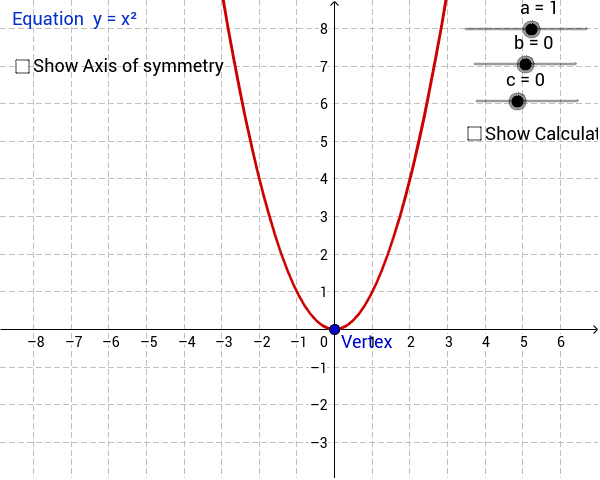
This example demonstrates how the axis of symmetry of a quadratic function shifts as the quadratic, linear, and constant coefficients change. It covers core concepts such as the standard form, vertex form, and the axis‑of‑symmetry formula x = -b/(2a). Construction highlights: the Intersect command finds the intersection of the parabola with its symmetry axis, using objects a, b, c, d, e, point A, function f, text2, auxiliary line g, and text1. Suitable for high‑school algebra (functions chapter) and for middle‑school enrichment or self‑study.
GeoGebra Commands & Parameters
Intersect(d, e, 1) → A
AI Drawing Prompt Reference
Draw a parabola and show its axis of symmetry. The parabola is defined by a quadratic function, and the axis of symmetry formula is x = -b/(2a). Mark a point on the parabola and draw a line to represent the axis of symmetry. Ensure the graph is clear and label key points like the vertex and axis of symmetry.
The prompt above was compiled from the original drawing commands and is for reference only.