
Average Rate of Change Example
Loading the math board and drawing, please wait…
In collections
CCGPS AA Unit 6 Lesson 5
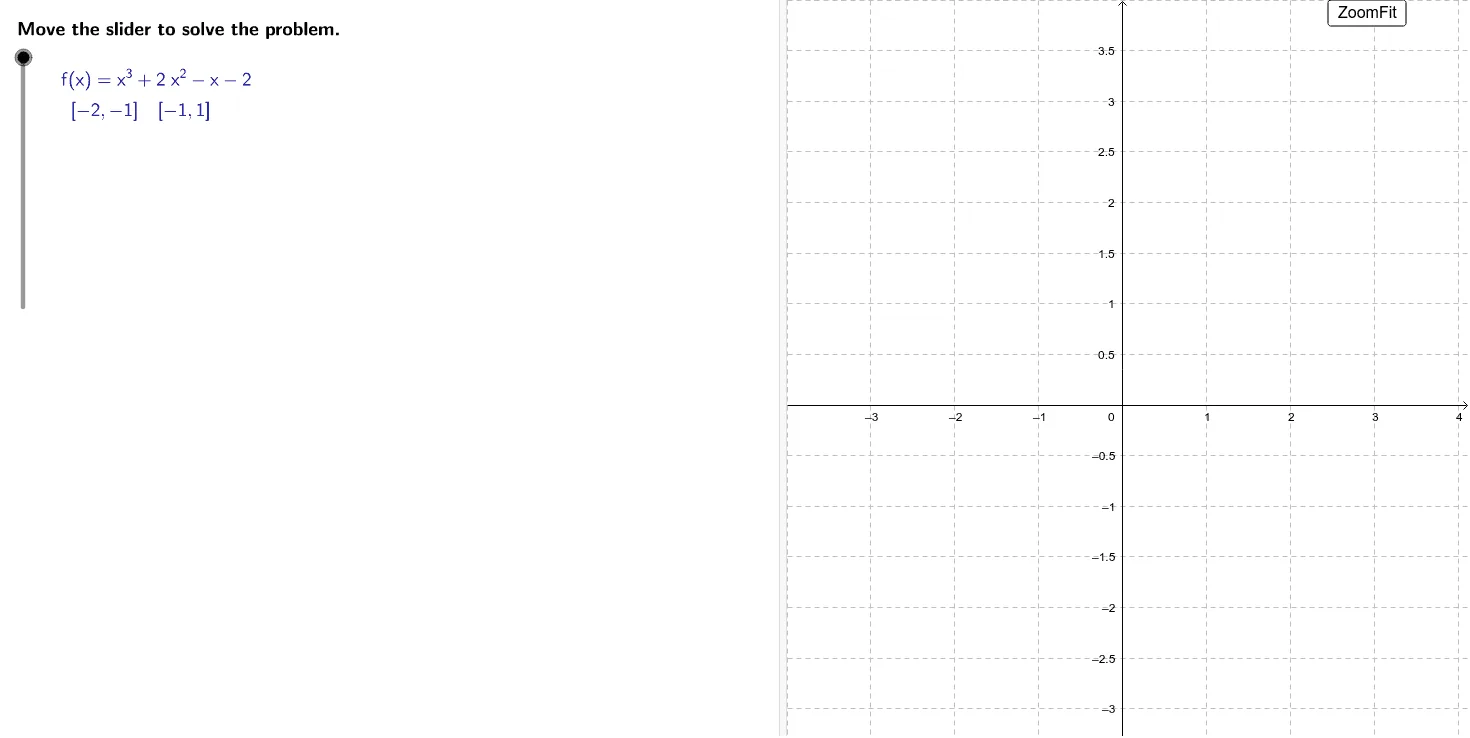
This example demonstrates how to calculate the average rate of change of the function f(x) = x³ + 2x² – x – 2 over the intervals [-2, -1] and [-1, 1]. It involves core math concepts like functions, intervals, and change rate calculation. Construction highlights the use of GeoGebra commands/objects such as LaTeX, Polynomial, Sort, Sequence, TableText, Element, Coefficients, Flatten, and Sum. Suitable for high school students learning calculus.
GeoGebra Commands & Parameters
LaTeX(steps) → counterLaTeX("\text{Move the slider to solve the problem.}") → text0Corner(1) → ACorner(3) → BPolynomial((((x - a) * (x - b)) * (x - c))) → fZip(If[a ≟ 1, b, 100], a, map, b, ends) → pickEndsSort(pickEnds \ {100}) → usedEndsSequence(LaTeX[(((("[" * Element[usedEnds, i]) * ",") * Element[usedEnds, i + 1]) * "]")], i, 1, Length[usedEnds] - 1) → intervalsTableText({intervals}) → intervalDisplayLaTeX((((("\textcolor{#000099}{f(x)=" * f) * "}\cr\textcolor{#000099}{") * intervalDisplay) * "}")) → ProblemElement(intervals, chooseInterval) → chosenIntervalLaTeX((("\text{Calculate the average rate of change of }\textcolor{#000099}{f(x)}\text{ over the}\cr\text{interval }\textcolor{#000099}{" * chosenInterval) * "}.")) → text1LaTeX((((("\text{First find the values of }\textcolor{#000099}{f(" * Element[usedEnds, chooseInterval]) * ")}\text{ and }\textcolor{#000099}{f(") * Element[usedEnds, chooseInterval + 1]) * ")}.")) → text2Coefficients(f) → coeffsLaTeX((("\text{Calculate }\textcolor{#000099}{f(" * Element[usedEnds, chooseInterval]) * ")}.")) → text3LaTeX((("\textcolor{#000099}{f(x)=" * f) * "}")) → text5LaTeX((((("\textcolor{#000099}{f(" * Element[usedEnds, chooseInterval]) * ")=") * f(Element[usedEnds, chooseInterval])) * "}")) → text7LaTeX((("\text{Calculate }\textcolor{#000099}{f(" * Element[usedEnds, chooseInterval + 1]) * ")}.")) → text8LaTeX((("\textcolor{#000099}{f(x)=" * f) * "}")) → text10LaTeX((((("\textcolor{#000099}{f(" * Element[usedEnds, chooseInterval + 1]) * ")=") * f(Element[usedEnds, chooseInterval + 1])) * "}")) → text12Element(usedEnds, chooseInterval) → LendElement(usedEnds, chooseInterval + 1) → RendLaTeX("\text{Simplify.}") → text18LaTeX((("\textcolor{#000099}{r=" * r) * "}")) → text19Zip((a, f(a)), a, usedEnds) → showEndsSequence((f(Element[usedEnds, i]) - f(Element[usedEnds, i + 1])) / (Element[usedEnds, i] - Element[usedEnds, i + 1]), i, 1, Length[usedEnds] - 1) → rateListZip(If[a < 0, "negative", If[a > 0, "positive", If[a ≟ 0, "zero", "undefined"]]], a, rateList) → rateWordTableText({intervals, rateList, rateWord}, "v") → text24If(Defined[IndexOf["positive", rateWord]], LaTeX["\text{When the average rate of change is positive on}\cr\text{an interval, the function rises more than it falls}\cr\text{on that interval.}\cr"], "") → wordposIf(Defined[IndexOf["zero", rateWord]], LaTeX["\text{When the average rate of change is zero on an}\cr\text{interval, the function either is constant}\cr\text{throughout the interval (a horizontal line) or has}\cr\text{the same value at the ends of the interval and}\cr\text{moves away from that value and then back. The}\cr\text{second possibility results in at least one}\cr\text{maximum or minimum on the interval.}\cr"], "") → wordzeroIf(Defined[IndexOf["negative", rateWord]], LaTeX["\text{When the average rate of change is negative on}\cr\text{an interval, the function falls more than it rises}\cr\text{on that interval.}\cr"], "") → wordnegIf(Defined[IndexOf["undefined", rateWord]], LaTeX["\text{When the average rate of change is undefined on}\cr\text{an interval, either the interval has zero width or}\cr\text{at least one of the endpoints is undefined.}\cr"], "") → wordundeSequence(Sequence[If[Element[rateList, i] ≟ Element[rateList, j], 1, 0], i, j + 1, Length[rateList]], j, 1, Length[rateList]) → matchFlatten(match) → flatmatchSum(flatmatch) → summatchIf(summatch > 0, LaTeX["\text{}\cr\text{Note that just because the average rate of}\cr\text{change in two intervals is the same does not}\cr\text{mean that the function behaves identically in}\cr\text{the two intervals.}\cr"], "") → matchedLaTeX(((((wordpos * wordneg) * wordzero) * wordunde) * matched)) → text25LaTeX("") → text22LaTeX("\text{Original function}") → text4LaTeX("\text{Original function}") → text9LaTeX("\text{Rate of change formula}") → text14LaTeX((((("\text{The rate of change of }\textcolor{#000099}{f(x)}\text{ over the interval }\textcolor{#000099}{" * chosenInterval) * "}\text{ is }\textcolor{#000099}{") * r) * "}.")) → text20LaTeX((((("\text{Substitute the values for }\textcolor{#000099}{f(" * Lend) * ")}\text{ and }\textcolor{#000099}{f(") * Rend) * ")}\text{ into the rate of change formula and solve.}")) → text13LaTeX("\text{Use the buttons below to return to the original problem or}\cr\text{randomly generate a similar practice problem.}") → RandomizationTextLaTeX((("\text{Substitute }\textcolor{#000099}{" * Element[usedEnds, chooseInterval]) * "}\text{ for }\textcolor{#000099}{x}\text{ and simplify.}")) → text6LaTeX((("\text{Substitute }\textcolor{#000099}{" * Element[usedEnds, chooseInterval + 1]) * "}\text{ for }\textcolor{#000099}{x}\text{ and simplify.}")) → text11LaTeX("\textcolor{#000099}{r=\frac{f_1(x) - f_2(x)}{x_1-x_2}}") → text15LaTeX((((((((("\text{Substitute }\textcolor{#000099}{" * fleft) * "}\text{ for }\textcolor{#000099}{f_1(x)}\text{, }\textcolor{#000099}{") * fright) * "}\text{ for }\textcolor{#000099}{f_2(x)}\text{, }\cr\textcolor{#000099}{") * Lend) * "}\text{ for }\textcolor{#000099}{x_1}\text{, and }\textcolor{#000099}{") * Rend) * "}\text{ for }\textcolor{#000099}{x_2}.")) → text16LaTeX((((((((("\textcolor{#000099}{r=\frac{(" * f(Lend)) * ")-(") * f(Rend)) * ")}{(") * Lend) * ")-(") * Rend) * ")}}")) → text17LaTeX("\text{Graph the function and the endpoints of the intervals.}") → text21LaTeX("\text{Determine if the rate of change over each interval is positive, negative, 0, or undefined, }\cr\text{and whether the rates of change for different intervals are the same.}") → text23
AI Drawing Prompt Reference
Draw the graph of the function f(x) = x³ + 2x² – x – 2, highlighting the average rate of change over the intervals [-2, -1] and [-1, 1]. First plot the function, then mark the two intervals. Calculate the average rate of change for each interval by dividing the change in function values by the interval width. Indicate the rate of change for each interval with different colors or symbols, showing whether it is positive, negative, or zero. Finally, add text annotations explaining the meaning of the average rates of change for each interval.
The prompt above was compiled from the original drawing commands and is for reference only.