
Average Chord Length in a Unit Circle
Loading the math board and drawing, please wait…
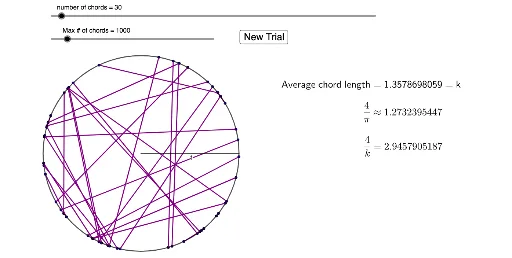
This example demonstrates the average length of a random chord in a unit circle. Key mathematical concepts include the properties of circles and probability statistics. Using GeoGebra commands such as Sequence, First, Sum, Circle, and Segment, the construction allows for a clear understanding of the distribution of random chord lengths in a unit circle. Suitable for high school mathematics education and learning.
GeoGebra Commands & Parameters
Sequence(((random() * 2) * π), i, 1, g) → M_0First(M_0, n) → MSequence(((random() * 2) * π), i, 1, g) → L_0First(L_0, n) → LSequence(Rotate[D, Element[L, i]], i, 1, n) → L_1Sequence(Rotate[D, Element[M, i]], i, 1, n) → L_2Sequence(Segment[Element[L_1, i], Element[L_2, i]], i, 1, n) → L_3Sum(Element[L_3, i], i, 1, n) → bCircle((0, 0), 1) → dSegment(A, D) → f
AI Drawing Prompt Reference
Draw a unit circle and randomly draw multiple chords inside it to calculate the average length of these chords. First, generate a series of random angles, then rotate the diameter around these angles to form the endpoints of two chords, connect these endpoints to form the chords, and finally calculate the total length of all the chords.
The prompt above was compiled from the original drawing commands and is for reference only.