
ASA Congruence: Two Angles and the Included Side Equal
Loading the math board and drawing, please wait…
In collections
Triangle Congruence Activities
Triangle Congruence Activities
Triangle Congruence Activities
Triangle Congruence Activities
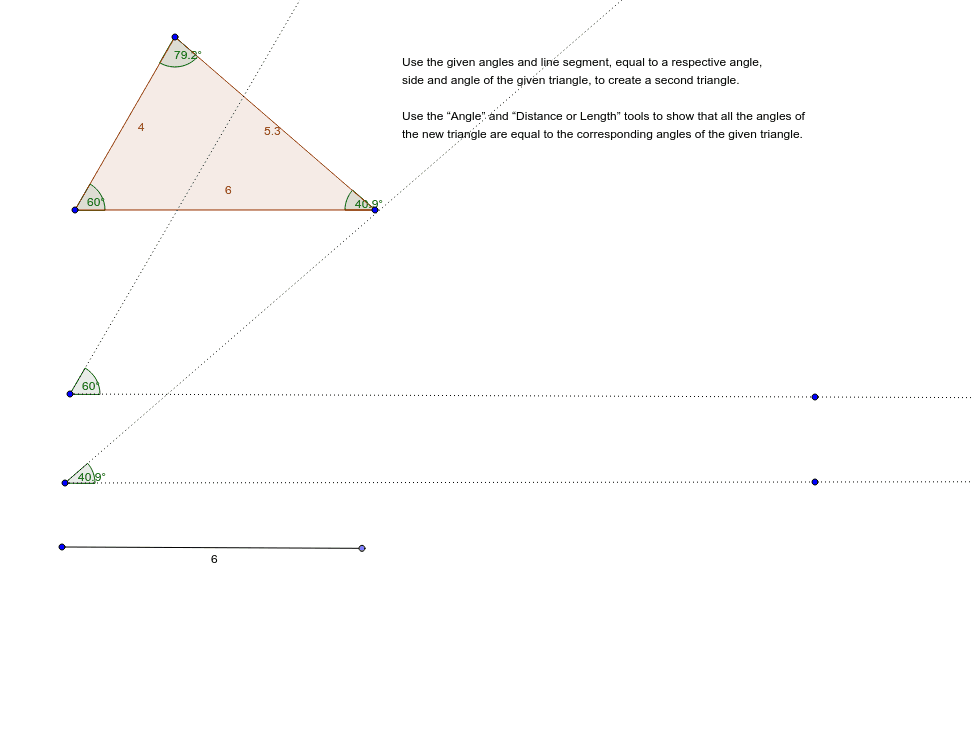
This GeoGebra activity demonstrates the ASA (Angle-Side-Angle) congruence criterion: if two triangles have two pairs of congruent angles and the included side between those angles is congruent, then the triangles are congruent. The core mathematical concept is triangle congruence, specifically the ASA postulate, which relies on angle measurement, side length, and rigid transformations such as rotation and translation. The construction uses GeoGebra commands including Polygon, Point, Segment, Angle, Ray, and Rotate to build two triangles, then rotates one triangle to superimpose it onto the other, while displaying angle labels (α, β, γ) and side labels (c, a, b) to visually confirm corresponding elements match. This resource is suitable for middle school or high school geometry classes, helping students grasp the ASA congruence rule through interactive exploration, and can be used for teacher demonstrations or student self-study.
GeoGebra Commands & Parameters
Polygon(A, B, C) → poly1, c, a, bPoint(Circle[H, Distance[A, C]]) → ISegment(H, I) → fAngle(A, B, C) → αAngle(B, C, A) → βAngle(C, A, B) → γRay(J, K) → gRotate(K, γ, J) → K'Angle(K, J, K') → δRay(J, K') → hRay(D, E) → dRotate(E, β, D) → E'Angle(E, D, E') → εRay(D, E') → e
AI Drawing Prompt Reference
Draw two triangles. The first triangle has three vertices labeled as the first, second, and third points. The second triangle has corresponding vertices labeled as the fourth, fifth, and sixth points. Construct the first triangle and measure its three interior angles, labeling them as α, β, and γ, and label its three sides. Then, from the fourth point, draw a ray starting at the fifth point. Rotate the fifth point around the fourth point by angle γ to get a new point, and draw a ray from the fourth point through this new point, forming an angle equal to γ. Next, from the fourth point, draw a ray starting at the sixth point. Rotate the sixth point around the fourth point by angle β to get another new point, and draw a ray from the fourth point through this new point, forming an angle equal to β. Finally, in the first triangle, draw a circle centered at the second point with radius equal to the distance from the second point to the third point. Pick a point on this circle as the seventh point, and connect the second point to the seventh point with a segment, so that the two triangles have two pairs of equal angles and the included side between them equal.
The prompt above was compiled from the original drawing commands and is for reference only.