
Argand Diagram: Visualizing Cartesian and Exponential Forms of Complex Numbers
Loading the math board and drawing, please wait…
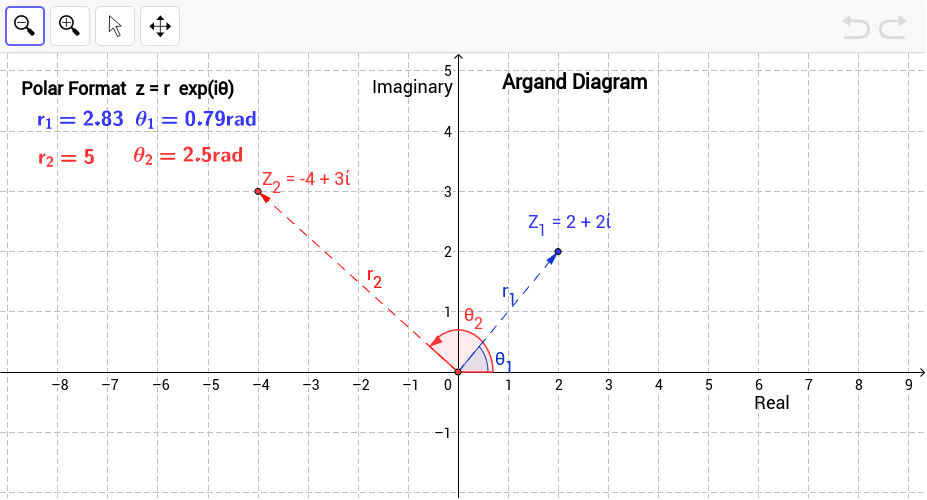
① This example demonstrates an Argand diagram that shows the direct correspondence between a complex number's Cartesian coordinates and its polar/exponential representation (modulus and argument). ② Core mathematical concepts include complex numbers in algebraic and polar form, modulus, argument, and the geometric interpretation of complex numbers as vectors. ③ Construction highlights: GeoGebra commands Intersect, Vector, Point, and Angle are used to create points Z_1, Z_2, B, D, vectors u, v, w, z, angles θ_1, θ_2, α, and radii r_1, r_2, with text objects labeling each quantity. ④ Suitable for high‑school complex‑number lessons, introductory university complex analysis, and as a dynamic geometry‑construction teaching resource.
GeoGebra Commands & Parameters
Intersect(xAxis, yAxis) → BVector(B, Z_1) → uVector(B, Z_2) → vPoint(xAxis) → DAngle(D, B, Z_1) → θ_1Angle(D, B, Z_2) → θ_2Vector(B, w) → z
AI Drawing Prompt Reference
Draw an Argand diagram with the origin, two complex points Z1 and Z2 and a third point w, each shown as a vector from the origin representing its modulus; place a reference point on the real axis, mark the angles from the positive real axis to each vector as their arguments, and label each vector’s modulus and argument so the Cartesian and polar/exponential forms correspond directly.
The prompt above was compiled from the original drawing commands and is for reference only.