
Hyperbolic Number Multiplication and Inversion
Loading the math board and drawing, please wait…
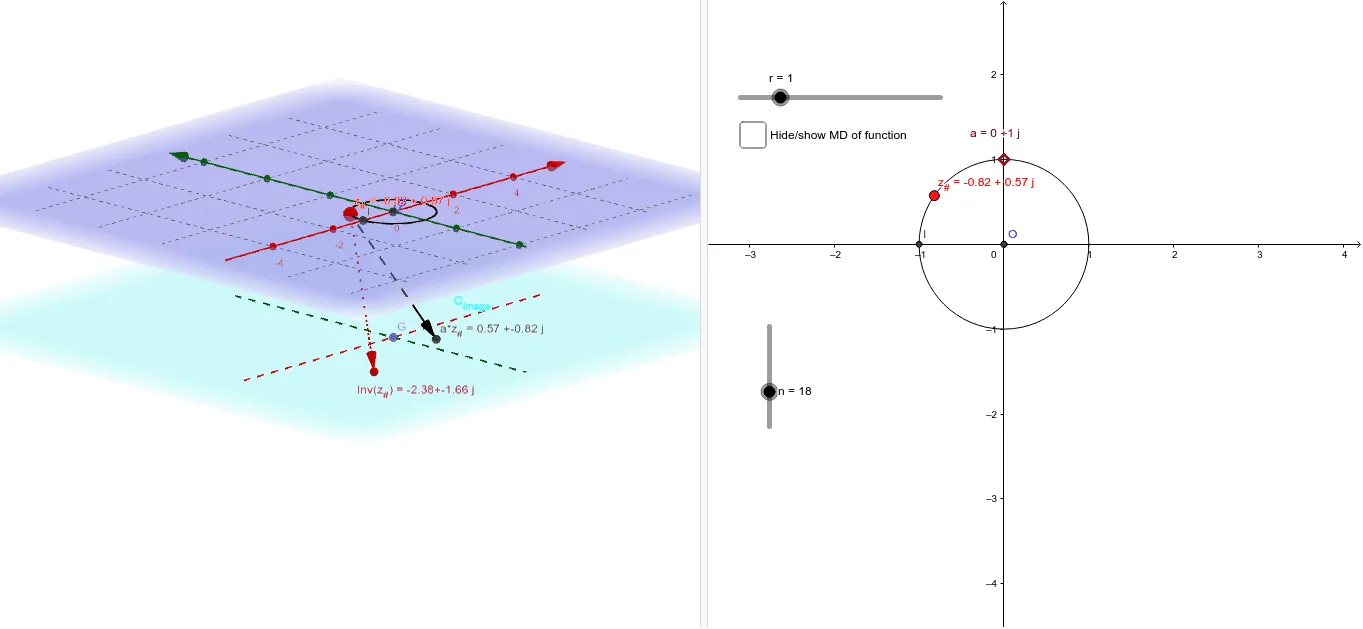
This example demonstrates the geometric representation of multiplication of hyperbolic number z by real number a and inversion of z. It involves core mathematical concepts like hyperbolic numbers, multiplication, inversion, and coordinate transformations. Constructed using GeoGebra commands and objects such as Point, Sequence, Zip, CurveCartesian, Textfield, Intersect, Sphere, Vector, Ray. Suitable for high school and above students to understand the algebraic and geometric properties of hyperbolic numbers.
GeoGebra Commands & Parameters
Point(C_O) → z_#Sequence((r * cos(t)) + x(O) + ((y(O) + (r * sin(t))) * ί), t, -3.14159, π, (2 * π / n)) → z_*Zip(fz(z), z, z_*) → fz_1CurveCartesian((r * cos(t)), (r * sin(t)), ht, t, 0, 6.283185307179586) → d_1Textfield(f_{(z#)}) → inputBox2CurveCartesian(t, 0, ht, t, -5, 5) → XhCurveCartesian(0, t, ht, t, -5, 5) → YhTextfield(z_*) → inputBox3Intersect(xAxis, yAxis) → BSphere(A, B) → fVector(C, z_#) → uRay(C, z_#) → gIntersect(g, f) → D, ESphere(F, G) → hIntersect(zAxis, h, 1) → HTextfield(Fz) → inputBox1Sequence(Vector[(0, 0, 2), Element[z_*, j]], j, 1, n) → ProjVectz_*Sequence(Intersect[Line[Element[z_*, j], (0, 0, 2)], f], j, 1, n) → Projz_*Point(C_O) → KVector(z_#, PfzK) → vZip({{x(A), y(A)}, {y(A), x(A)}}, A, z_*) → l1Zip((A * Ma), A, l1) → l2Zip((Element[A, 1, 1], Element[A, 1, 2], ht), A, l2) → l3Zip(Vector[A, B], A, z_*, B, l3) → fvec_*Intersect(C_O, xAxis, 1) → IVector(z_#, Invz) → w
AI Drawing Prompt Reference
Draw a 3D coordinate system with a horizontal plane and a vertical axis. On the horizontal plane, place a unit circle centered at the origin. From the origin, draw a ray in an arbitrary direction intersecting the unit circle at two points. Mark a point on this ray as the complex number, and draw a vector from the origin to this point. On the vertical axis, choose a point and draw a projection line from it to the complex point, intersecting a unit sphere to obtain a projected point. Additionally, draw a set of equally spaced rays from the origin on the horizontal plane, each intersecting the unit circle, and generate corresponding projection vectors. Place three input boxes for entering the complex number, its function value, and its inverse. Finally, draw vectors from the complex point to its inverse point and to its function value point, illustrating the geometric relationship of hyperbolic number multiplication and inversion.
The prompt above was compiled from the original drawing commands and is for reference only.